

According to a study carried out by Opinion Way (2022), psychological distress is thought to affect 41% of French employees, 14% of them at a high level. According to the WHO, mental health at work has become a societal issue - employee wellbeing having never been so much under threat. And for good reason: when working conditions affect employees’ mental health, the result is psychological distress.
Harvard Business Review has also revealed that 72% of millennials have already left a job for a reason connected to mental health. Worth noting: 91% of these millennials want the company culture to be conducive to mental health.
Faced with this less-than-cheering picture, companies must respond and place their employees’ wellbeing at the heart of their HR policy. Promoting the right to make mistakes, continuous feedback, transparency of information... they have a thousand levers for looking after their workforce’s mental health.
To explore the subject, we spoke with Julia Néel Biz (co-founder of Teale) and Marie Barbier (HR Director, Morning), who share some practical advice.
Changing the way we look at mental health, with Julia Néel Biz, co-founder of Teale
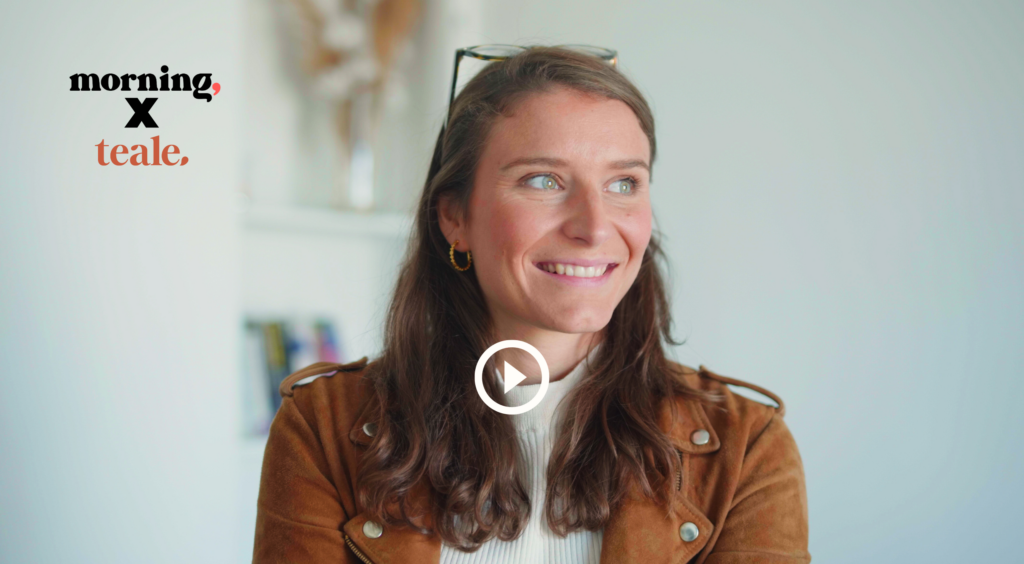
For many years, Julia Néel Biz has been committed to the subject of mental health at work. The co-founder of Teale shares an overview of the mental health of French workers, and it is not exactly a rosy one.
As a preamble to our conversation, Julia recalls the WHO’s definition: “mental health is a state of wellbeing that enables everyone to realise their potential, cope with the normal difficulties of life, work successfully and productively, and be able to make a contribution to their community”.
“This definition reveals a certain way of seeing things. In France, mental health is too often associated with illness or care. We would be well advised to change the way we look at it! Since the end of Covid, one might have expected a fall in cases of psychological distress. Yet for 3 years now, more than 40% of employees have been affected by psychological distress. 22% of sick leave is due to a problem related to mental health.
(Read also: Mental health at work, with Teale)
More and more organisations are looking into the matter. This consideration is sometimes prompted by an out-of-the-ordinary event (a death within a team, a case of harassment, and so on) that calls for specific support for certain individuals. But most often it is in a spirit of prevention, with a desire to support employees so that they look after themselves before risks arise.”
☞ Preventing risks, spotting the warning signs
“Teale’s support is both individual - to help each person look after themselves in a positive and preventive way, tailored to them; and collective - to transform company culture and prevent risks at organisation level. Our approach is grounded in the cognitive and behavioural sciences, but also in data, which allows continuous monitoring of teams’ mental health, confidentially and anonymously, of course.
Certain shifts in the data bring warning signs to light: “Less meaning in my work” - “Poorer sleep” - “Less inclined to go to work in the morning” - “Workload too high.” These drop-offs are symptomatic of an organisation that is malfunctioning. The cost of poor team health is very real!
It is estimated at €3,000 per employee per year. This figure is explained by unwanted departures, absenteeism and presenteeism (harder to quantify, but very real all the same).
How do you make sure employees feel good in their own heads? How, collectively, do you prevent risks? Every organisation must put in place rituals to take the pulse of its team regularly and then act accordingly. For example, by setting up training courses, moments of exchange and workshops - both for employees (“How do you manage your stress?”; “Learning to say no!”) and for managers (e.g. “Burnout: how do you detect the weak signals?”).”
(Read also: Kindness and wellbeing at work)
Julia Néel Biz’s advice to employees is simple: “Listen to yourself and make your mental health a priority. It does a great service to yourself and to those around you. My advice to managers and leaders is to set an example, to own their vulnerability, to have done with the myth of the superhero. As a leader, knowing how to balance your life, acknowledge your limits, or observe the right to disconnect, for example, will carry a lot of weight, because it gives team members permission to do the same.”
(Read also: Work/life balance: a crucial issue)
Mental health at work: doing everything to build trust

Marie Barbier, HR Director at Morning, shares some practical advice to apply within a company in order to work in a healthy environment.
Sharing your troubles with those close to you, or sometimes even simple feelings, is hard enough as it is. So confiding this sort of thing to your coordinator or your line manager at work looks even trickier. Do you not risk being judged, being seen as a weak link?
For Marie Barbier, the company must counter these self-defence behaviours by creating a framework of trust capable of freeing up speech, in order to change how certain human relationships are read. It is no longer about confessing a weakness but about sharing a feeling with courage; it is not about apologising for anything, but about putting energy back in the right place.
To begin or continue this transformation, Marie Barbier shares 4 practices rolled out within the Morning team. She points out that these are only particular sources of inspiration; everyone will of course have their own way of doing things.
- Establish reassuring routines
“Choose the processes that match your culture. You can invent them, but bear in mind that a great many practices already exist. At Morning, we strive to promote the right to make mistakes, to make breaks compulsory and to practise constructive feedback. So over to you!”
- Be available
“Dialogue and exchanges must not be an exceptional occurrence. The less fuss or ceremony there is, the more regular and spontaneous the sharing will be. In concrete terms, leaders and the HR team must state and restate their availability, even initiating conversations spontaneously about everyday situations. You must not wait for the ‘off’ moments. As there is no one-size-fits-all solution, you will need to support each employee as much as possible. A ‘bespoke’ listening ear will be the first step in this work.”
- Invent as a team
“I’ll say it again: the all-purpose solution, valid for everyone, does not exist. Ideally you would tailor everything, but there will never be enough time. Even so, to bring as many people as possible along with your processes, build them with your workforce. Survey your employees, organise workshops, set the objectives together. You have to co-create in order to make the best choices and build a climate of trust.”
- Favour “test & learn”
“Even when you think collectively about the best possible formula, people offer no guarantee of success up front. There is no point dreaming up long-term strategies; only experience counts. Opt for an empirical approach, that of an ‘HR lab’. Test your ideas, observe the results. Within 2 months, you will know whether the formula was the right one or whether you need to readjust. And if it’s a resounding failure? Take it as an opportunity — you’ll get to test other ideas!”
******
You now know pretty much everything about the processes put in place at Morning to allow everyone to protect their mental health. If you have ideas to add to the subject, do share them with us in the comment field below!
Our team is available to assist you.

Download our new study
Nouveaux bureaux : ce qu'attendent les salariés
.png)

.jpg)