

Given that a company relocates on average every 3 to 5 years, it is best to give yourself every chance of success in your search for offices in Paris.
To help you in this process, we spoke with Georges Blasco, a sales adviser at Morning, who supports companies day in, day out in their quest for the ideal office. The must-ask questions, adjusting your criteria, the number of viewings, negotiating levers... Georges shares his tips for a successful search for offices in Paris.
1. Three points to consider before you start
The importance of consulting the teams beforehand
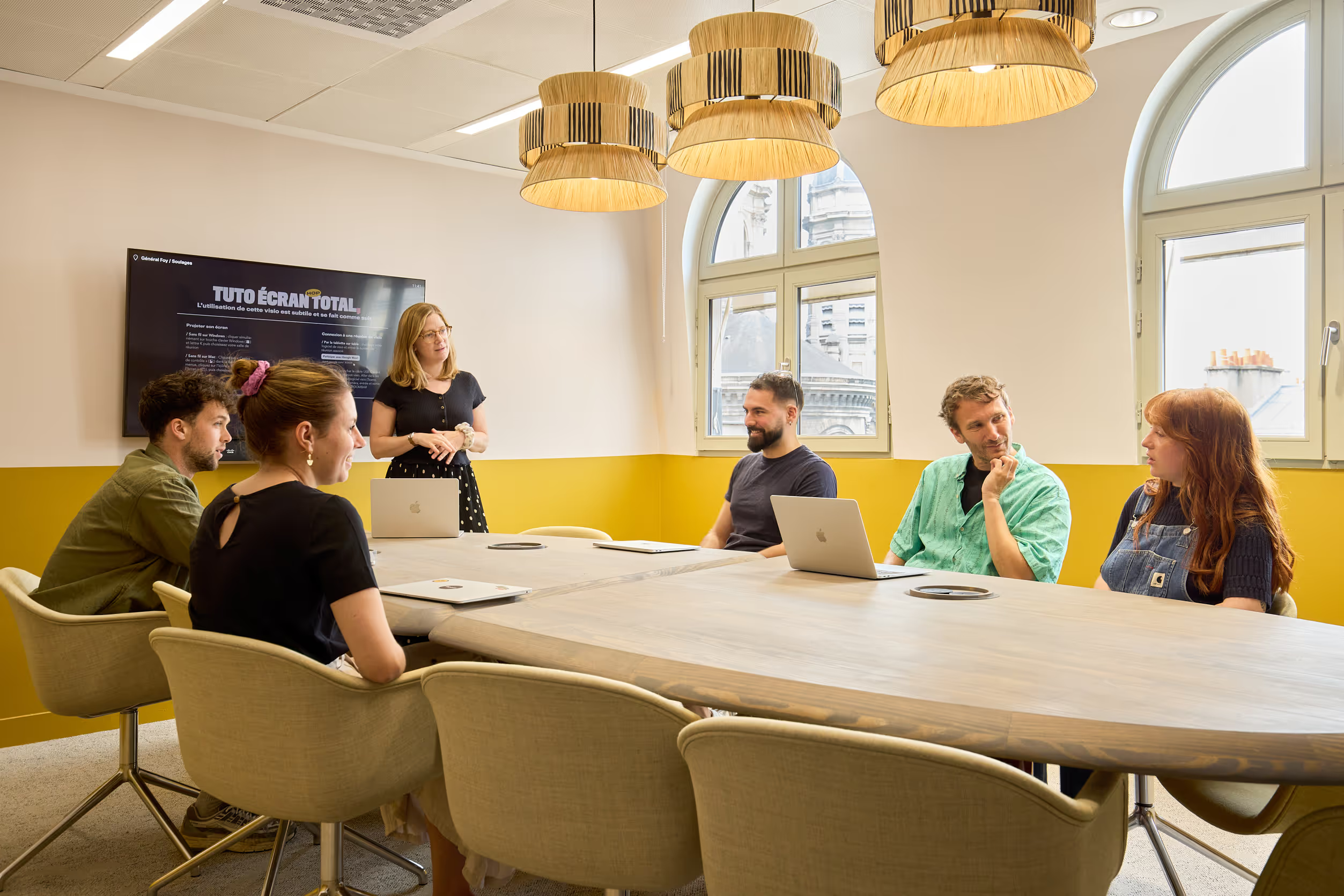
The success of an office project comes above all from a good understanding of the team's real needs. Beyond simply the number of workstations required, it is essential to analyse how each person works and to anticipate the uses.
Remote work has profoundly changed needs: a team of 20 people can now function perfectly well with 16 workstations, provided flex office is well organised. The aim is to create an environment that fosters both individual concentration and collaboration, while adapting to the different rhythms of office attendance.
This thinking goes beyond the number of workstations. To give you an idea of the ratios for arranging your workspaces, allow on average one meeting room per 30-35 people, and one phone box per 4 workstations. These standards, tried and tested, guarantee a perfect balance between collaborative spaces and concentration zones.
Need information on setting up flex office simply?
The realistic timescales to plan for
Let's talk frankly about timescales, because depending on the contract you are considering, they can vary twofold, sometimes more.
For a traditional 3/6/9 lease, forget the idea of an express move: allow 6 months minimum. But the sooner the better, because this timescale covers the search itself, but also the negotiations, the signing of the lease, and above all the fit-out of the premises. Because yes, between handing over the keys and your teams actually moving in, you need to allow time to equip the spaces, set up connectivity, and manage all those details that make the difference between empty offices and a functional workspace.
Operated offices offer more flexibility, with timescales of 2 to 3 months generally. As for shared workspaces, they are the express solution par excellence: a few weeks can be enough for a complete move-in, with a certain amount of room to fit out and decorate your space and truly feel at home.
But be warned: even in this case, don't underestimate the time needed to compare offers and view different spaces.
A wider budget bracket
A small point about your budget. While everyone obviously knows the amount to set aside for a project of this scale, set yourself a bracket of +/- 20% of your initial budget. This will allow you to view properties that are sometimes a little more expensive but could well turn out to be love at first sight. It will allow you to stay open to certain options during your viewings.
2. Which district to choose in Paris?
Transport accessibility, the key criterion
To put it plainly, your teams spend on average 235 days a year travelling to the office. Proximity to transport hubs is therefore a decisive criterion. All the more so when you know that the quality of the home-to-office journey directly influences job satisfaction and the ability to attract talent.
Indeed, close to one in two working people would reportedly be prepared to take a pay cut to work less than 20 minutes from home (the Paris Workplace barometer produced by IFOP-SPL 2020).
The RER A stands out as the strategic axis favoured by companies whose employees come from the west and east of Paris, from Cergy through to Marne-la-Vallée. Line 9 is also a good axis to target: crossing Paris from west to east, it is the busiest. It notably serves the 8th and 9th arrondissements which continue to attract financial firms and large groups, faithful to their historic DNA.

The districts where it is good to work in Paris (on a smaller budget)
Rents in the QCA (Central Business District) can reach up to €740/m²/year. The Silicon Sentier (2nd arrondissement) remains the beating heart of French tech, with its unique ecosystem of start-ups and scale-ups.
But plenty of other districts, just as pleasant, show prices per m² that are lower (between €300 and €450) such as Boulogne or Saint-Ouen with the opening of line 14. Bagnolet even shows a bracket of between €120 and €350/m².
In this dynamic of renewal, La Défense is also enjoying a second wind. After going through a difficult period following the Covid-19 crisis with a high vacancy rate, the business district is reinventing itself through ambitious greening projects. This ecological transformation, coupled with a strategy of opening up to companies of all sizes, is bringing new momentum to the historic district of western Paris, and all at an accessible price.
To find all our Morning spaces located in these districts, this way here.
3. Choosing between different office rental options in Paris
In your search for offices in Paris, you can choose between several contracts: 3/6/9 leases, operated offices and shared workspaces. Each of these options has its advantages. We explain it all.
The 3/6/9 lease
The traditional commercial lease is the rental option with which you will have the most autonomy. This formula is particularly suited to companies that have a clear vision of their development and want to create a bespoke environment. But beware the responsibilities that go with it: from maintenance to managing service providers, everything rests on your shoulders.
Not to mention the commitment over several years, which can become a straitjacket if your needs change rapidly.
The operated office
Picture a furnished flat, professional version: that is the essence of operated offices. This hybrid solution offers the privacy of a building or a private floor with a service package equivalent to that of shared workspaces. No more juggling ten different providers: everything is included, from electricity to cleaning by way of maintenance. A particularly relevant choice for companies that want to focus on their core business rather than on property management.
The shared workspace (or coworking)
The term "coworking" is sometimes misleading. The shared workspace does not refer only to a place where freelancers gather, far from it. Between the "1 workstation" formula and the "single-tenant floor for a headcount of 120 people", the options vary.
The major asset? Flexibility, of course, but also access to quality shared services: meeting rooms, a gym, kitchen areas, a lounge, and so on. Every need will find its space. The aim of this offer is to provide a more complete experience, with services and proposals that bring the office to life. A criterion that is rarely discussed but that can make all the difference.
In administrative terms, simplicity is the watchword. You sign a service contract in which the notice periods are very short (between one or two months).
4. Knowing the costs and the negotiating levers
The hidden costs to identify
Beware of surprises that can blow your budget! Some operators apply entry fees that can reach a hundred euros or so per workstation - a sum that can quickly add up for a sizeable team.
In 2024, while the average rent in the QCA reaches €740/m²/year, don't forget to add the charges and taxes, which represent on average 20% of the rent excluding VAT.
A tip: always ask for the full breakdown of costs after your first viewing.
The points to watch in contracts
Comparing offers can sometimes feel like a Chinese puzzle: on one side, traditional leases in m²/year, on the other, coworking priced per workstation per month.
To see clearly, ask for the shared-space allocation:
The "allocation" of a space is the percentage of the shared area attributed to a company (or a client) according to the size of its private space. This valuable information will allow you to compare offers in terms of cost/m2 and so avoid nasty surprises.
Don't hesitate either to ask about the exit conditions and the possibilities for growth within the same space.
The possible negotiating levers
In property as elsewhere, everything is negotiable - you just need to know how. The length of commitment remains your best asset: the more you commit for the long term, the more favourable the conditions you can obtain.
And bear in mind the vacancy rates: with 14.4% at La Défense against 2.3% in the QCA, your negotiating power varies considerably from one area to another.
A final tip, by way of conclusion
The key to a successful search for offices in Paris? Don't put all your eggs in one basket. Consult at least 2 to 3 different players in the market. This approach will allow you not only to compare offers, but also to discover unexpected opportunities.
With an immediate supply of 4.9 million m² in the Île-de-France region, take the time to explore, to view, to picture yourself there. You are not just choosing walls, but the future living environment of your teams.
Our team is available to assist you.

Download our new study
Nouveaux bureaux : ce qu'attendent les salariés
.png)


.jpg)