

.avif)
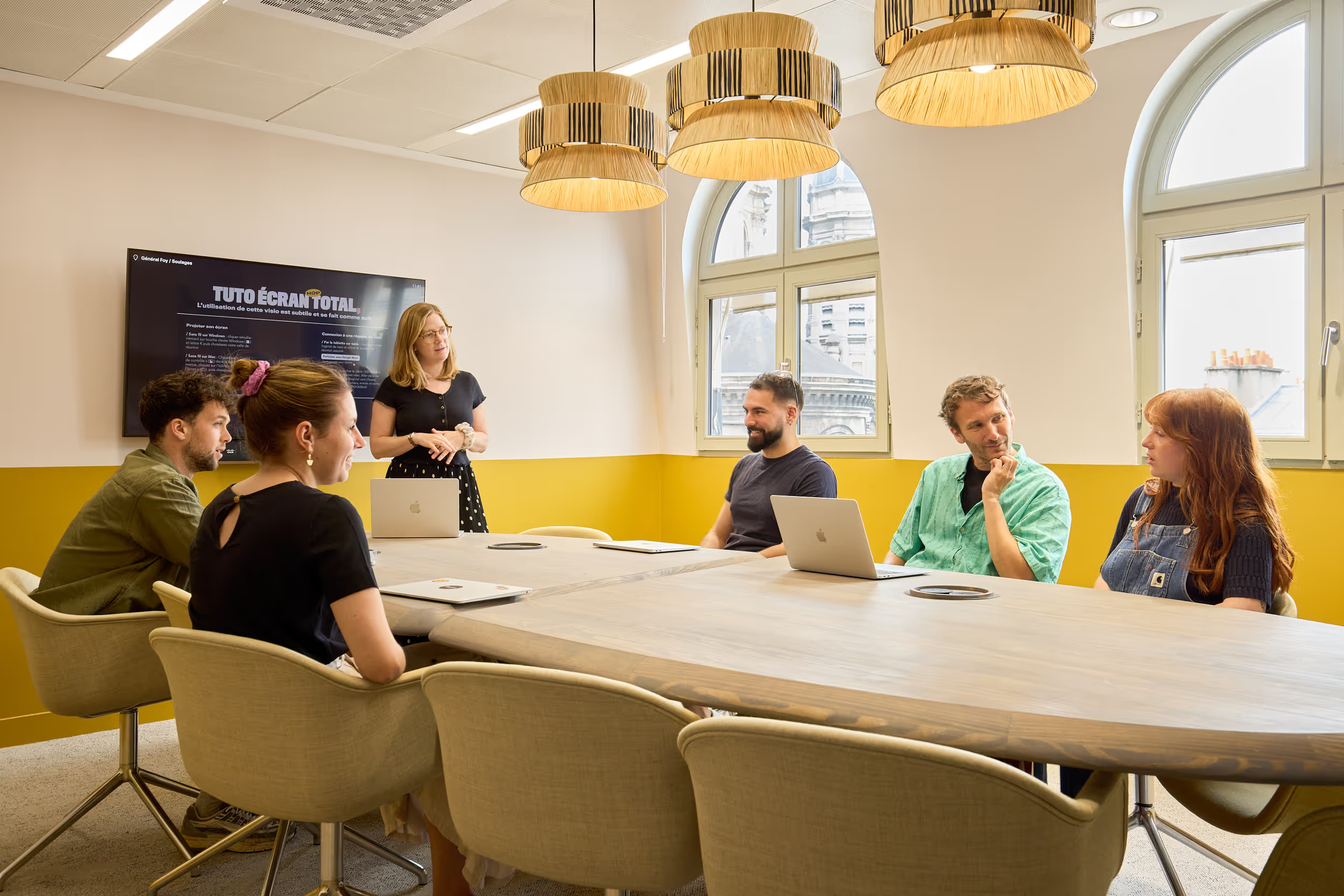
Environmental impact is a central concern for furniture designers and manufacturers. Many players in the sector are developing concrete solutions to reduce their consumption of materials and energy. To explore some recent initiatives, the Morning team held a round table on 11 September 2024 as part of Paris Design Week.
The discussion was led by Hélène Bertolone (Head of Impact at Morning), alongside the guests: Emna Kamoun (Lecturer-researcher at Stratdesign) - Sandra Rodrigues (Account Manager at MillerKnoll) - Didier Poisson (Business Manager at Interface) - Armand Bernoud (co-founder of Maximum). These professionals, with their varied backgrounds and areas of expertise, shared their vision for reconciling design, production and sustainability.
By way of introduction, Emna Kamoun stressed the importance of building planetary boundaries into the design stage from the outset: "Considering impact must not come as an afterthought; it must be taken into account before you even begin to conceptualise." This systemic approach, taking in environmental, social and political impacts, illustrates the complexity of the challenges the industry faces.
On a more practical level, our three industry professionals face a set of shared challenges:
- Raising client awareness
- Evolving business models
- Measuring environmental impact precisely
But each one puts forward a meaningful solution at a different stage of the production chain.
MillerKnoll: designing for repairability
For this leader in the office furniture market, sustainability has been a central concern ever since the company was founded in the 1950s.
For Sandra Rodrigues, the challenge lies above all in the materials, and innovation is at the heart of this quest. The company is banking on modularity and the ability to easily replace worn parts.
"We have office chairs launched 30 years ago that you still see everywhere on the market, and they aren’t all new products – a great deal of it is second-hand.", notes Sandra Rodrigues.

The idea is to produce intelligently, taking account of the constraints as well as the areas for improvement, in order to offer durable solutions while minimising the impact of the entire chain of products, right through to the end of their life.
Interface: an introduction to random design
At Interface, a leader in floor coverings, the shift to a circular model began back in 1994.
"The idea was to turn our linear model into a circular one and to take action at every stage of the life cycle", explains Didier Poisson, Business Manager.

In practical terms, this direction translates into eco-design of products, the use of recycled materials and bio-based ones, as well as end-of-life management. Interface has thus put in place solutions to reuse and recycle its worn carpet tiles.
The company has also rethought the design of its products to make them easier to reuse. This led them to develop random design, where each tile is slightly different. This makes it possible to mix production batches and to reduce offcuts during installation, as Didier Poisson explained.
Maximum: design made from waste
At Maximum, a company co-founded by Armand Bernoud, upcycling is at the heart of the business model. The company makes furniture from the waste of other industries.

"All the raw material comes from the material offcuts generated by other manufacturers producing at scale."
This approach makes it possible to make use of waste that would otherwise be difficult to recycle. For example, Maximum produces its Billex stools from shredded worn-out banknotes. The whole point of these pieces is to use the plastic contained in the notes as a binder, and to use thermo-compression to turn them into a rigid material.
The challenge is to design products suited to the constraints of these unusual materials. You can’t start from a blank sheet; you have to make the most of what the material can offer. This means having to completely rethink the entire design and production process.
Inspiration for everyone
As a design professional, you have an important role to play in moving the furniture industry towards more sustainable practices.
Here are a few ways to contribute to this transition:
• Gradually build the principles of eco-design into your projects.
• Explore the possibilities offered by recycled materials and upcycling, wherever it makes sense.
• Work with other players in the sector to develop more responsible solutions.
• Keep up to date with new practices and technologies that support sustainability.
• Raise your clients’ awareness of environmental issues and offer them more responsible alternatives wherever possible.
At Morning, we’re aware that improving our environmental impact is an ongoing process. Day after day, project after project, we’re working to reduce our carbon footprint. We invite you to discover our approach which, like yours, is constantly evolving. By sharing our experiences and our lessons learned, we can all help move the design and furniture industry towards more sustainable practices.
We explain it all right here 👉Morning measures its carbon footprint
Our team is available to assist you.

Download our new study
Nouveaux bureaux : ce qu'attendent les salariés
.png)
.jpg)