

When Morning embarked on a fresh round of B Corp recertification, the goal was not to add another badge to an “About” page. B Corp certification is an in-depth audit of how a company operates: governance, workers, environment, communities (both communities and suppliers) and customers.
The framework comprises more than 200 questions, spread across five broad categories, alongside a set of legal requirements. Every answer must be documented. It is not about declaring an intention, but about providing evidence: written policies, HR indicators, minutes from internal bodies, energy reporting, formalised processes, traceability of volunteering hours, supplier data, governance arrangements.
Transparency is the rule: the majority of the answers are made public on the B Corp platform. It is therefore impossible to “dress up” a reality that cannot be evidenced. Without systems, without data, without processes, the points are simply not awarded. To go beyond the 80-point threshold and aim for a score above 90, you have to industrialise impact.
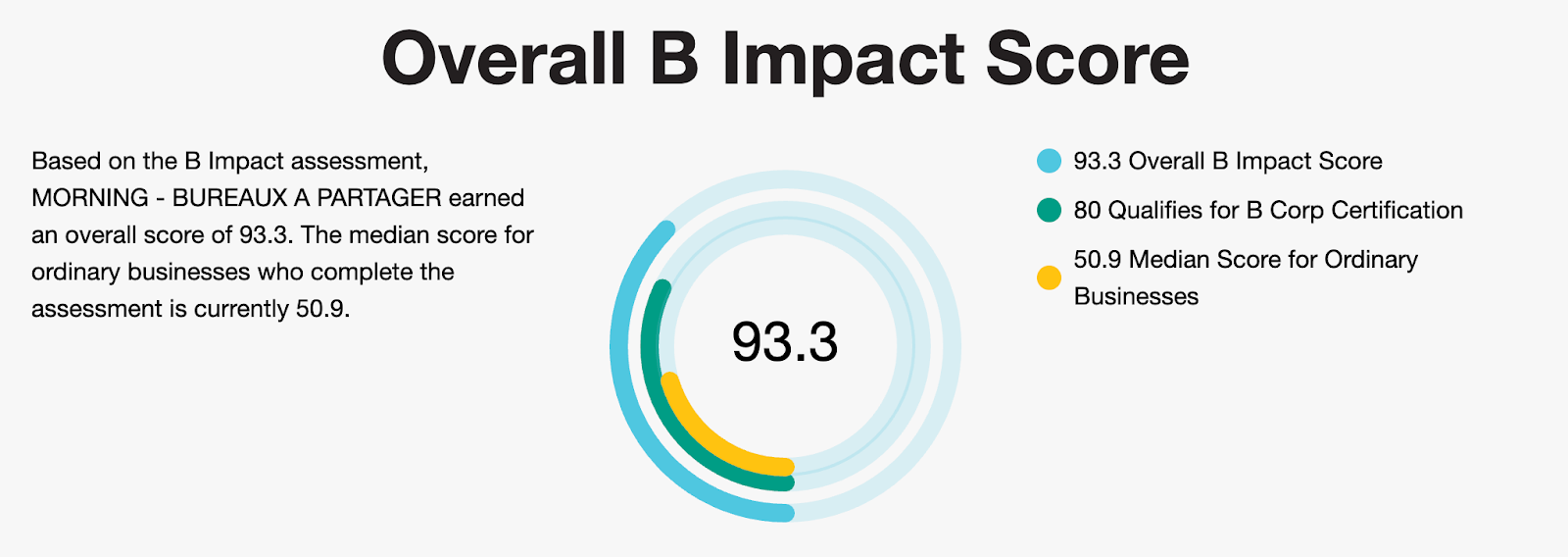
First certified in 2022 with 81.5 points, Morning achieved a score of 93.3 points in 2025, a rise of almost 12 points. Behind this improvement lie structuring organisational choices and initiatives carried out over several years.
1. “Project-based working”: the key to saving time (and avoiding burnout)
A B Corp recertification is a project in its own right. The work began in November 2024. The answers were submitted in April 2025. What followed was almost nine months of exchanges with the auditors: requests for clarification, additional documents, methodological queries.
A dedicated cross-functional team
Fourteen employees were mobilised, drawn from different functions: HR, operations, finance, fit-out and management. This internal firepower made it possible to collect the data, formalise practices that were sometimes implicit, and structure the evidence.
A certification carried out without a dedicated team can lead to delays, a diffuse extra workload and points lost for want of supporting evidence.
The pivotal role of an adviser
Morning was supported by the consultancy Wiser Impact, in particular by Estelle Lauvergne and Sophie Conchon.
A specialist consultancy does not “do” the certification in the company’s place. Its role is to translate the framework into evidence requirements, to challenge the grey areas and to safeguard the relationship with the auditors.
2. Four high-impact initiatives, turned into actionable lessons
The rise in the score rests on concrete actions, structured over time. Each one can be read as a repeatable “pattern”.
Building an external impact engine
Morning launched the Morning Accelerator, in partnership with Standard Deviation and Nexity. Two seasons have supported responsible solutions in fit-out and construction: new materials, energy-efficient renovation, and the reuse of water and waste.
Within the B Corp framework, this kind of initiative is recognised when it rests on a clear architecture: formalised cohorts, selection criteria consistent with the strategy, structured support, and follow-up of the solutions over time. Credibility also rests on the ability to demonstrate that these collaborations do not remain theoretical, but translate into experiments — and even genuine integration into the spaces in operation.
Embedding employee engagement
Since 2024, every member of staff has had two half-days a year to carry out a mission with partner charities. In two years, 122 missions have been completed. Among the missions on offer:
=> With École Comestible, staff supervise pupils during a sustainable-cooking workshop centred on “good junk food” — a concrete, playful way of raising younger generations’ awareness of more responsible eating.
=> With Linkee, they help prepare and hand out solidarity food parcels, serve hot drinks, sign in the beneficiaries and lend a hand packing away the equipment, with 4 places available to join François on this mission.
=> With Solidarités Nouvelles pour le Logement (SNL), they help give a supported-housing flat a complete refresh, between painting and minor repairs, to welcome new tenants living in great precarity, with teams of 4 to 6 people per half-day.
Once again, what is assessed here is the ability to build a system. Formalised agreements with the charities, tracking of the hours completed, structured internal communication, feedback loops: all of these make it possible to prove that engagement does not rest on individual initiative but on a company-wide policy.
Gradually, volunteering is becoming an integral part of HR processes. It is anticipated, planned and valued. It is this repeatability and this traceability that give the approach substance and allow it to evolve over time, rather than confining it to a one-off symbolic gesture.

Steering the environment through data
Morning has rolled out an energy-management system with Lite, itself a product of the Accelerator. This partnership makes it possible to measure consumption across the entire portfolio, optimise contracted capacities, adjust usage and produce regular reporting.
The dashboards, consumption reports and trends measured against floor space in operation constitute tangible evidence. Data not only makes it possible to steer, but also lends credibility to the trajectory under way.
Strengthening governance
Setting up the Copilot — a management body that includes members of staff in managerial roles — has strengthened internal transparency and participation in structuring decisions.
Morning also scores points on workplace equality and on employee share ownership.
B Corp rewards companies capable of making their governance more robust, less dependent on a single figurehead and more firmly rooted in clear processes. Turning a company culture into a formalised system is demanding, but it is precisely this formalisation that guarantees the continuity and credibility of the commitment over time.
3. What remains difficult
A score of 93.3 points does not mean that every subject has been mastered.
Some categories, notably the customers category, are structurally harder to activate when the business model is not directly geared to improving the environmental impact of the customers themselves. These limits are part of the reality of the framework: certain questions can only be “unlocked” by transforming the core business in depth.
The recertification also made it possible to identify a dozen internal areas for improvement, now managed as long-term projects.
4. A road map already under way
The work does not stop at recertification.
Several structuring actions are planned:
- Completing the 2026 carbon assessment with Carbon Cutter, in order to define a quantified trajectory for the following two years.
- Reducing the carbon footprint of building works: responsible sourcing, reuse, and stronger sorting and recycling.
- Setting up a cross-company impact committee to share CSR best practice within the fit-out sector.
- Strengthening inclusion, disability and diversity policies.
A B Corp certification is neither a trophy nor a slogan. It is a demanding framework that brings strengths to light, but also blind spots.
The value of the exercise lies as much in the audit as in the score. The questions left unanswered become strategic priorities. The points gained reflect an ability to structure, measure and steer.
The progression from 81.5 to 93.3 points illustrates a journey. The credibility of the approach rests precisely on the fact that some areas remain complex and costly. B Corp acts as a compass: it points in a direction, without promising an immediate result.
Our team is available to assist you.

Download our new study
Nouveaux bureaux : ce qu'attendent les salariés
.png)

.jpg)