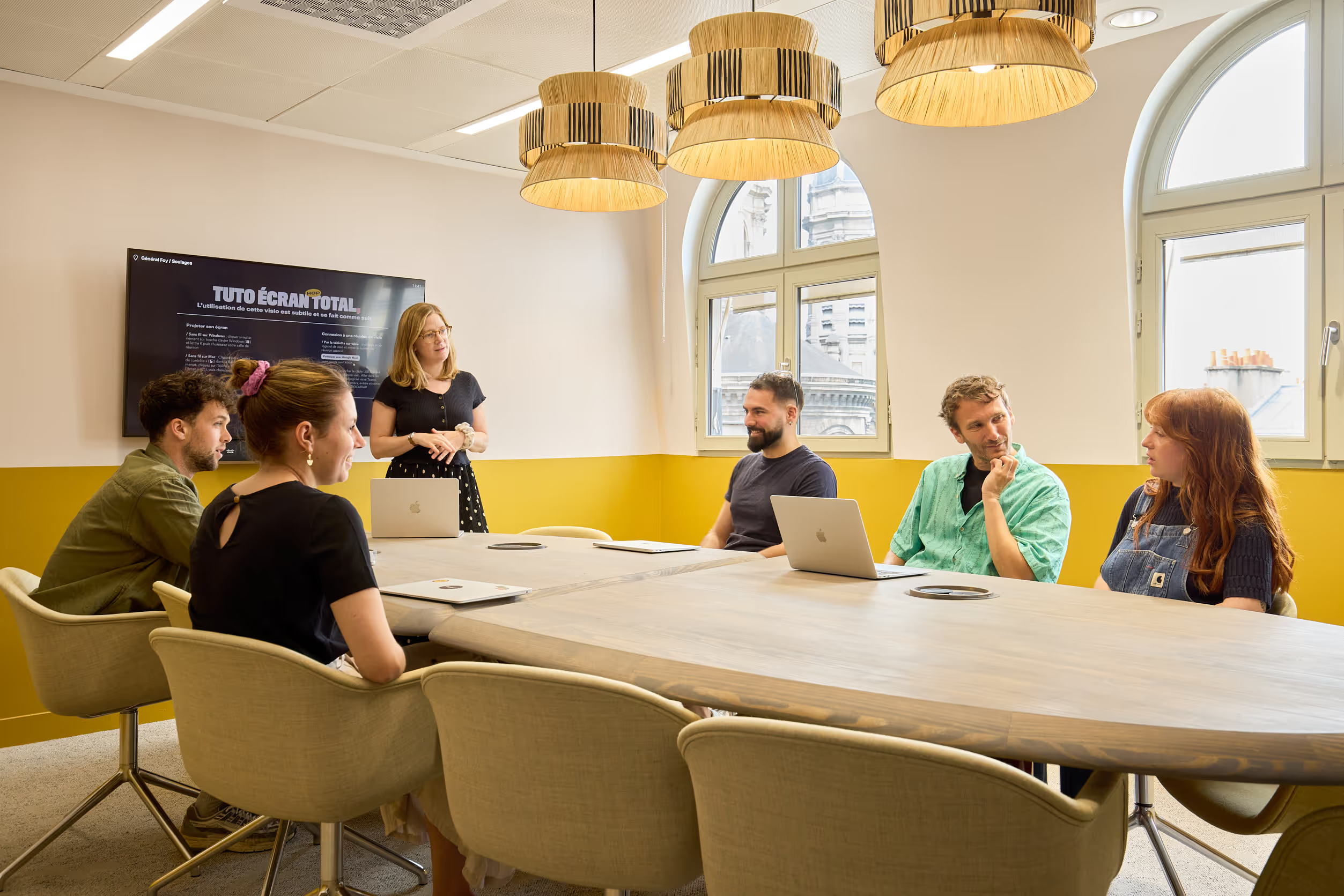


This was the big question that animated the Bureau des Talents round table in March 2025, led by Flore Villemot-Crozet (HR Consulting Director at Boson Project). Around her, two guests with complementary profiles: Maxime Wagner, Co-founder and CEO of Captain Contrat, and Gaspard de Stabenrath, Managing Director of Morning. Both shared, before an audience of HR leaders, their experiences and concrete tips for staying the course when the horizon is not always entirely clear.
As Maxime and Gaspard operate within organisations of different sizes and activities, here is a brief description of each structure to better grasp their point of view:
- Captain Contrat offers online legal services in the field of business creation and management (employment contracts, changes to a company’s articles of association, company closures, commercial contracts, and so on). Founded in 2013, the company brings together nearly 40 team members who support entrepreneurs and company directors in their day-to-day work.
- Morning designs workspaces so that companies and their teams can have a good day at work. The company runs its own spaces (50 spaces in Paris and the greater Paris region) and also fits out offices for external clients. The team, which celebrated its 10th anniversary in 2024, now numbers close to 300 people.
At the heart of the matter: employee engagement
What is it that makes employees stay, work and invest themselves in the company? What keeps them on board, especially during difficult times?
Since engagement is above all a deeply personal undertaking, it cannot be imposed. It is an individual choice that the company can encourage by creating a favourable environment, but that it cannot force.
This personal dimension, once established, naturally creates strong bonds with the collective. The beauty of engagement lies in its ability to turn the individual into the collective. When it is authentic and shared by everyone, it becomes an exceptional driving force, particularly precious when navigating difficult moments. It is what allows a team to surpass itself and hold the course, even in the face of obstacles.
What kind of uncertainty are we talking about?
Here we are talking about changing, unpredictable contexts that create instability and complicate projections and future decisions. Here are a few examples experienced by Maxime and Gaspard:
#1 Acquisition by another company: the uncertainty tied to an acquisition by another company raises concerns about both cultural and operational impact.
#2 Rapid growth (or decline): a necessary shift from a rapid-growth strategy to a focus on profitability, which calls for a reorientation of efforts.
#3 A failed fundraising round: a company had to reduce its headcount because its growth metrics were insufficient to secure additional funding.
#4 The impact of a health crisis: the Covid pandemic left workspaces empty and teams working remotely, creating financial uncertainty.
7 tips for engaging your teams in times of uncertainty
Over the course of the round table, Maxime and Gaspard shared a wealth of ideas and lived experiences. We have chosen to distil this content into 7 tips. Do listen to the audio recordings for more precise detail.
1. Bring the company’s values to life every day
This is the basis. To create and nurture a sense of belonging, the company’s values are a starting point. If every person in the collective identifies with these values, mutual support will be encouraged, and so will group life.
These values must be built collectively so that they are lived every day by everyone. They will allow each person to engage and invest themselves, especially when the company’s objectives and strategies evolve.
Maxime Wagner - on the company’s mission and its values :
2. Listen to the weak signals (through managers)
When it comes to detecting weak signals, the monthly surveys sent by HR to the entire workforce do not seem to be the most effective approach. At Captain Contrat, a manager-centred arrangement was put in place. It is the managers who run monthly one-to-ones where, beyond operational matters, employees’ feelings and outlook are discussed.
These conversations, held in a climate of trust and without traps, make it possible to pick up on signs of engagement or disengagement within the teams more effectively.
Maxime Wagner - on the importance of managers:
3. Establish regular communication
Maintaining regular, open communication keeps teams involved, thereby reducing rumours and misunderstandings. During the Covid crisis, Morning set up a weekly video call for the whole team. This regular communication helped strengthen commitment and maintain connection despite working remotely.
Gaspard de Stabenrath - on collective engagement during the Covid crisis:
4. Communicate transparently, but appropriately
There is broad agreement on the importance of transparency and trust as major levers of engagement. That said, they need to be calibrated intelligently according to the context and the people involved.
More specifically, you have to adjust the level of information shared to the level of understanding of the subject. Transparency does not mean telling everyone everything, but rather answering questions honestly while adapting the message so that it is constructive and understandable for each person.
Maxime Wagner - on the different levels of transparency:
5. Give employees responsibility
Giving employees responsibilities helps engage them further and gives them a sense of belonging and control, which is particularly motivating in times of uncertainty. For Gaspard, “this sense of responsibility leads employees to see the company’s challenges as their own”.
Maxime points out that autonomy must be calibrated according to each employee’s real skills and appetites, rather than being granted uniformly and without a framework.
Maxime Wagner - on the need to set a framework:
6. Turn employees into shareholders
Opening up the company’s capital to employees strengthens their engagement and their sense of belonging, aligning them with the company’s long-term success. At Morning, employee share ownership has been a “really strong and really powerful lever”, in Gaspard’s words.
“With three-quarters of employees holding shares in the company, it has created a different dynamic. Each employee has become a shareholder who has put into their company a piece of what they might otherwise have put into their flat.”
Gaspard de Stabenrath - on the profit-sharing arrangements at Morning:
7. Manage departures with empathy
When certain situations make it necessary to part with some of the workforce, it is important not to trigger a traumatic, demotivating situation for those who remain. It is better to anticipate and communicate transparently about the context and the reasons behind such decisions. Moreover, giving teams the choice to volunteer can be a good way of keeping people motivated, even if they are perhaps technically less skilled.
This transparent, respectful approach can strengthen the engagement of the remaining teams, entrusted with greater responsibility.
Maxime Wagner - on the difficult task of managing headcount reductions :
One last piece of advice
By way of conclusion, the 3 speakers share a piece of advice for taking your team with you in times of uncertainty.
Our team is available to assist you.

Download our new study
Nouveaux bureaux : ce qu'attendent les salariés
.png)

.jpg)