

The environmental impact of building sites often remains underestimated by many businesses, chiefly for want of any knowledge of the solutions available.
At Morning, we believe anyone can run a clean building site by adopting environmentally sound practices, from the design of the spaces right through to the use of eco-responsible materials.
To improve our impact, we assessed the carbon footprint of various elements such as furniture, flooring, partitions, and so on. We use the Life Cycle Assessment (LCA), an essential tool compliant with international standards. Whether you're working on new-build or renovation projects, the LCA gives decision-makers and professionals the ability to compare construction solutions, favouring those with the least impact in terms of emissions, waste, pollution and resource consumption.
While it's down to you alone to put in place the best system for measuring your CO2 emissions, we offer a few ideas here to significantly reduce the carbon impact of your building sites. These ideas are applied by Morning's "Impact/Fit-out" team on its own sites.

Tip no.1: "Go for second-hand furniture"
Furniture accounts for the largest share of CO2 emissions, at 51% of the total. To significantly reduce the impact of your building site, target the emission sources with the greatest volumes. Once you've pinned down your priority areas for action, you'll be able to act by pulling 2 levers.
☞ Lever 1: reuse your own furniture
When it comes to furniture, the most effective way to reduce the carbon footprint is reuse. This approach is not only eco-responsible but can also prove economical, following the "canny and thrifty" strategy: careful management of the budget coupled with a reduction in impact, thanks in particular to reuse.
By way of example, reusing the Herman Miller chairs - frequently found in the Morning spaces - achieves an impressive 93% reduction in emissions. This figure is obtained by comparing the impact of a reused chair versus that of a brand-new one. The carbon impact of this new furniture is available on the impact sheet for the Herman Miller chair.
☞ Lever 2: work with eco-responsible players
There are many eco-responsible brands in France or Europe that help promote the use of durable, recyclable materials. (Read also: “Reusing office furniture: there's still work to do!"). These eco-responsible brands are characterised by:
- a pared-back design,
- the use of durable materials,
- an optimised lifespan,
- the presence of labels such as FSC, PEFC, EU Ecolabel, OEKO-TEX, B-corp, Cradle to Cradle, and so on.
Here are a few examples of eco-responsible furniture frequently used on our building sites:
- For seating: HAY, Muuto, Artek, Gubi, Tiptoe, Tizu, Normann Copenhagen, and so on.
- For tables: Cruso, Ferm Living, Morning, Komut, and so on.
Tip no.2: "Avoid fully glazed partitions"
Despite being recyclable, glass is a material with a heavy environmental impact. The second largest source of CO2 emissions on a building site concerns glazed partitions: it accounts for 15% of the impact of Morning building sites.
The enthusiasm for glazed partitions, often double-glazed, is driven by the desire to create an upmarket feel and light-filled offices. However, these merits must be weighed against their significant environmental impact.
A few figures help to better grasp the impact of these glazed partitions:
- Opting for a solid partition avoids up to 65% of CO2 emissions per square metre compared with a full-height glazed partition.
- Choosing a glazed partition with a solid base reduces the impact by 30% of CO2 emissions per square metre compared with a full-height glazed partition.
Try wherever possible to find alternatives. You can already reduce the use of full-height glazed partitions by favouring partitions with solid bases, and sometimes even solid partitions. These choices can have a significant impact across all the square metres of the meeting rooms.
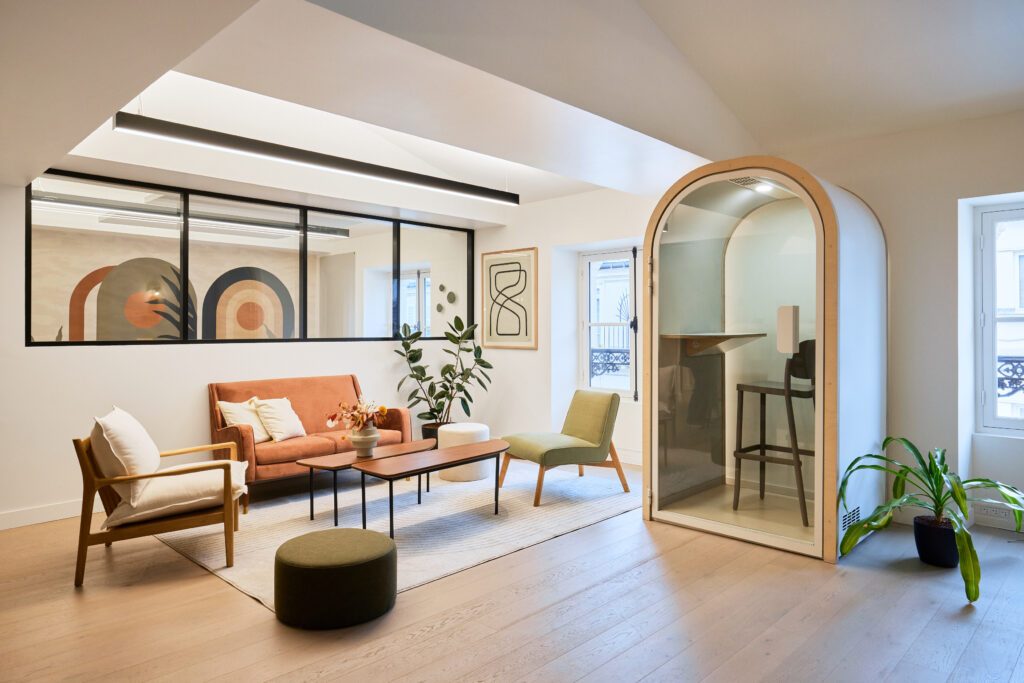
For every building site, the "Impact" team urges architects to explore alternative solutions to reduce our impact. Sometimes, though, extraordinary constraints will force us to use glass. For instance, at the Morning Trévise space, the heritage conservators forbade us from touching the wall. The solution chosen by the architects was to install free-standing pods, which aren't very eco-responsible.
Tip no.3: "Reuse electronics and appliances."
In third place among the most impactful sources, electronics and appliances combined generate 14.7% of CO2 emissions on a building site. A statistic worth taking seriously.
Adopting a responsible approach to electronics and appliances can prove tricky, given the scarcity of genuinely eco-responsible options. Nevertheless, reuse emerges as a promising strategy, capable of making a significant impact.
At Morning, we make the most of reuse by reusing the entire stock of electronic equipment and appliances when a space closes, for later use in another location. This opportunity for reuse, an advantage in our sector, also extends to private individuals thanks to services such as those offered by Murfy, who specialise in the repair, recovery and reconditioning of appliances at home.
Another example concerns buying electronics on platforms such as Backmarket Pro. Giving a second life to products such as televisions reduces CO2 emissions by 80% compared with buying new models. This principle also applies to dual monitors, where buying second-hand offers an eco-friendly alternative.
In all Morning spaces graded category A (a standard from our own calculation tool), large-scale reuse is common practice, taking in furniture (see tip no.1), flooring, glass doors, electronics/appliances, and much more.
Tip no.4: "Optimise your flooring, balancing quality and savings"
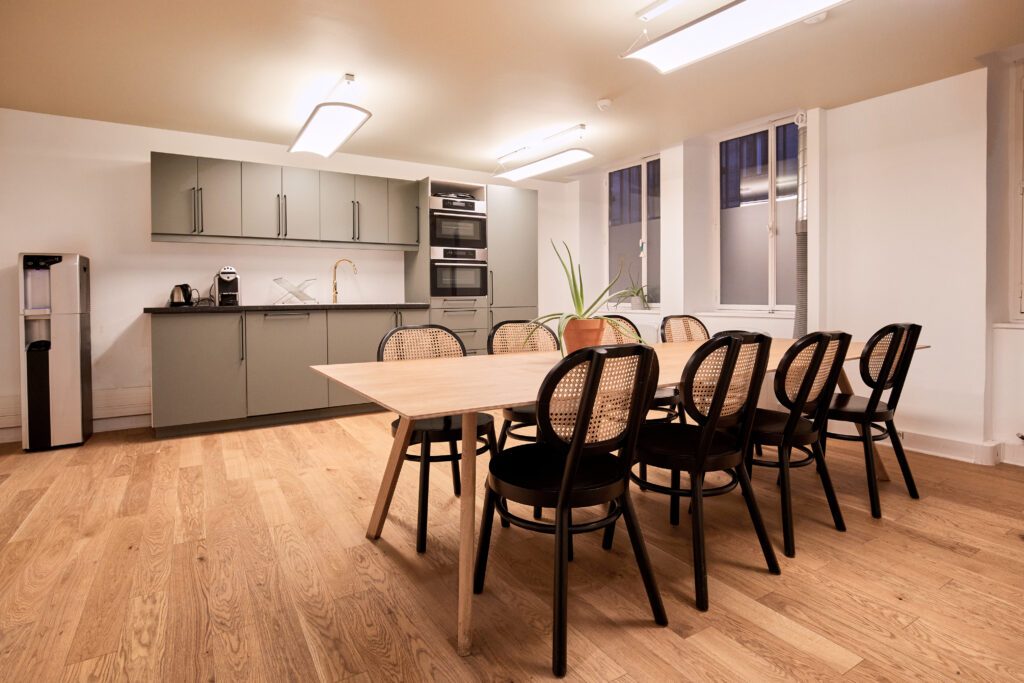
The fourth impact factor concerns flooring, which contributes 11.1% of CO2 emissions. Given the quantities required, choices in this area can exert a significant influence on the overall impact of a project.
Where budgets are tight, one possible option would be to go for laminate flooring or low-end "petroleum-based" carpet. However, more sustainable alternatives are worth considering:
- Solid wood flooring, optimal from an environmental standpoint, has 84% less impact, but it does entail a hefty budget.
- Engineered wood flooring offers a compromise between solid wood and laminate, striking a satisfactory balance between quality and cost.
As for carpet, an element in heavy demand, it's crucial to note that most carpets are made entirely of plastic. In this regard, Morning has carried out extensive sourcing work and identified the brand Interface, renowned for a composition comprising 80% recycled plastic along with a bio-sourced portion. These carpets turn out to be 75% less impactful than conventional alternatives.
As for gym flooring, the company Module Carré offers hard-wearing recycled rubber flooring, suited to gyms and warehouses. These modular tiles, economical and practical, are growing in popularity across all gyms.

***
Put together, these good practices will let you significantly reduce the impact of your building sites. By way of example, the Morning Beaurepaire space is a building site graded A thanks to the reuse of 7 televisions and 3 dishwashers (from former spaces), along with the reuse of 175 Morning desks and office chairs. What's more, all the solid wood flooring comes from surplus stock from the Morning Pont-de-Neuilly site. All these combinations made it possible to avoid a 45% increase in CO2 emissions, underlining the significant impact of reuse in our projects.
To assess the impact of your building sites, we advise adding an eco-responsible criterion to your design file alongside cost. When choosing materials, take into account both price and ecological impact, factoring the latter into your budget. These effective actions contribute to building sites that are kinder to the environment. It's up to you to put this information into practice.
******
You now know pretty much everything about the processes put in place at Morning to make it possible to run a clean building site. If you have ideas to add to the subject, do feel free to share them with us in the comment field below!
***
☞ Can your workspace be more responsible?
☞ Eco-designed furniture, by Morning.
☞ Building works: 4 responsible alternatives to conventional materials
Our team is available to assist you.

Download our new study
Nouveaux bureaux : ce qu'attendent les salariés
.png)


.jpg)