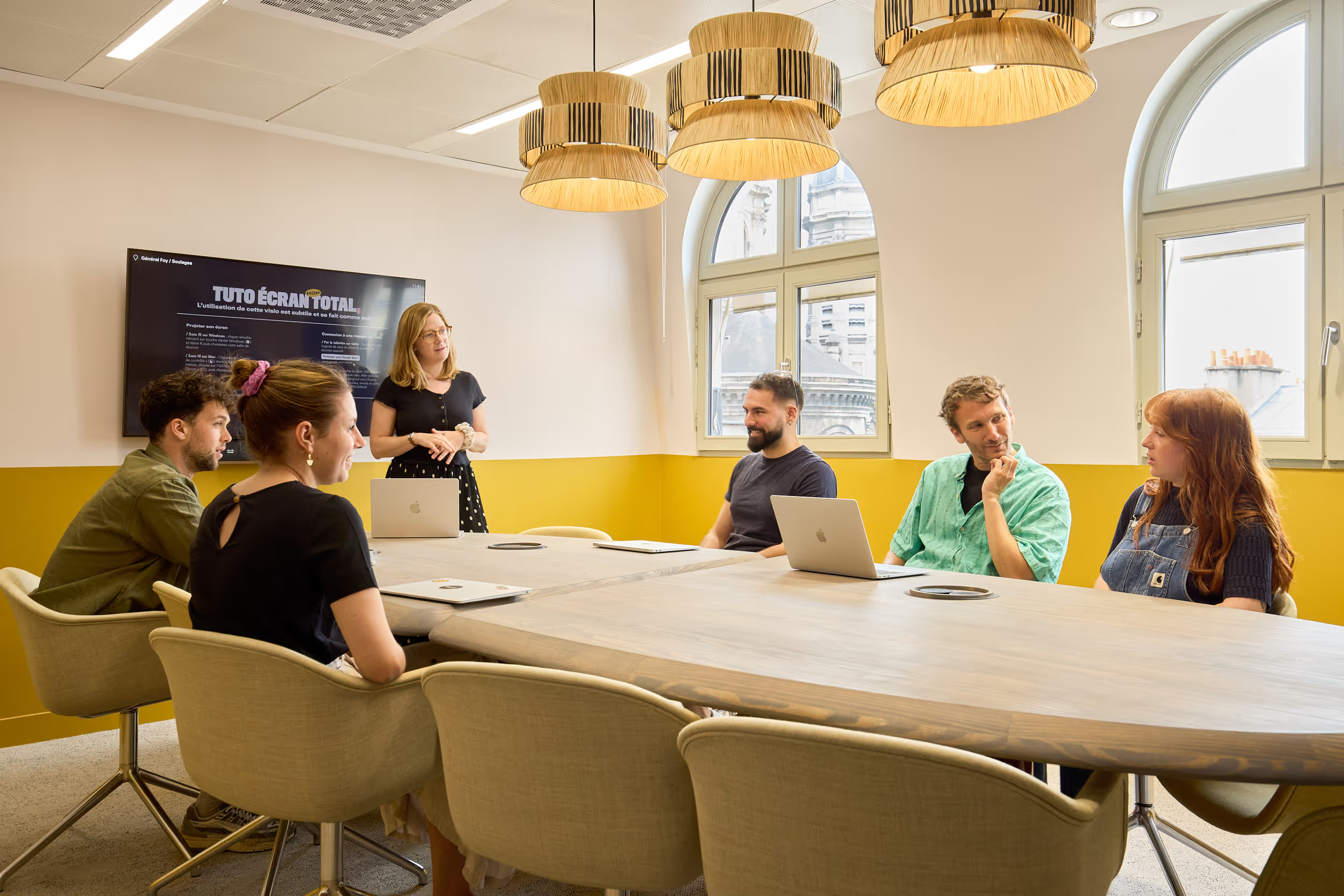


A look at how diversity makes us more creative
While the ability to create doesn’t depend on a single factor alone, diversity certainly plays an important part in setting creative and innovative processes in motion. Creativity is a vital resource in the world of work, as we see day to day at Morning. Today, according to studies, it ranks among the most sought-after attributes in professionals, and is also considered essential for entrepreneurs. Though it is often seen as a gift reserved for a lucky few, the truth may lie elsewhere. More and more companies need to show creativity in order to stay competitive, but the task isn't as simple as that. While having an innovative workspace may seem necessary, it isn't enough on its own. One of the methods many players use to develop creativity within their ecosystem is to increase the diversity of the people working within it. The problem: diversifying talent doesn't automatically guarantee a more creative company. That relationship does hold true, but only under certain conditions. Let us explain.
Diversity: a boost for creativity?
A great deal of literature demonstrates the links between promoting diversity and improving performance within organisations. A diverse team often brings different perspectives and distinct approaches to problem-solving. However, in order to unlock this potential, organisations need to change the way they view diversity. Several pieces of research suggest that diversity does not automatically translate into innovation. In particular, they show that there is a difference between generating ideas and implementing them. Diversity affects companies differently depending on which of these two goals is in play. Although the make-up of teams provides an advantage when it comes to generating original ideas, experimental studies suggest that these advantages disappear once the team is tasked with choosing ideas and putting them into practice, most likely because diversity can get in the way of consensus. That said, the positive relationship between diversity and creativity is well established. An article published by the Harvard Business Review shows that companies with a highly diverse make-up (based on two factors: inherent diversity — e.g. gender, background, etc.; and acquired diversity — e.g. experience abroad) are 45% more likely to report growth in their market share compared with the previous year, and 70% more likely to capture a new market.

A report by the consultancy BCG, for its part, shows a strong and significant correlation between the diversity of leadership teams and companies' overall innovation. Organisations whose management teams were more diverse than average reported innovation revenues 19% higher than those of companies with below-average diversity — that means 45% of total revenue for the former, against barely 26% for the latter. The solution involves not only increasing diversity, but also putting the right mechanisms in place to select the best ideas and practices from a diverse workforce, thereby unlocking the power of diversity.
How can you ensure diversity that generates creativity?
Rocio Lorenzo - who works at BCG in Munich - sets out five practices for ensuring diversity that generates creativity. All of them are ideas to put in place within the working environment.
Here is a brief summary of the 5 tips Rocio Lorenzo set out during her talk:
- Participative leadership. When managers listen to employees' suggestions and act on them, the benefits of diversity multiply. The Austrian company Swarovski uses what it calls mementos to remind leaders that their meetings will be more productive if participants take an active part rather than deferring to those who are more experienced. The reminders take various forms, including posters in corridors and whiteboard prompts in meeting rooms.
- Openness to cognitive diversity. Building a dynamic in which employees feel free to say what they think. The German company Unitymedia supports openness to cognitive diversity by encouraging disagreement and "constructive conflict" in discussions between employees and managers.
- Strategic priority. In some companies, diversity enjoys considerable backing from senior executives. That is the case at aviation giant Airbus, whose "Balance for Business" initiative (aimed at improving gender balance in a male-dominated company) is widely supported by the entire leadership, including the CEO.
- Frequent interpersonal communication. When companies find ways to make dialogue easier between people from different backgrounds, they can create a creative spark and strengthen innovation. Google does this through its cafés, which allow spontaneous encounters and conversations between people with different experiences, backgrounds and points of view.
- Equal employment practices. A concept that is neither new nor complicated, yet still isn't applied universally. Some companies are further ahead than others. The American clothing company Gap has completely eliminated pay differences between male and female employees. The company's commitment to diversity and gender balance is also reflected in the number of women on its leadership team and in the fact that the majority of its store managers are women.
☞ Read also: "The magic powers of collaboration (when 1+1 makes 3)"
Our team is available to assist you.

Download our new study
Nouveaux bureaux : ce qu'attendent les salariés
.png)


.jpg)