

What is the point of investing in beautiful workspaces if the connection drops in the middle of a client meeting? If the video call pixelates, if the Wi-Fi grinds to a halt at 10am, if a colleague cannot reach their files from the meeting room downstairs?
IT infrastructure is one of those things you never notice when it works, but that brings everything to a standstill when it fails.
And yet it is still too often treated as a technical constraint to be dealt with last, once the layout plans are finalised and the furniture ordered. That is a costly mistake.
According to the Bruit de couloirs study carried out by Appinio and Morning in 2025, 47% of office workers feel that the lack, or poor quality, of digital tools disrupts their working days. When IT infrastructure is poorly managed, it becomes a direct brake on performance.
Wi-Fi is good. Network security is essential.
When we talk about IT infrastructure in an office, Wi-Fi is often the first thing that comes to mind. But reducing IT to the quality of the connection means missing the essentials.
Behind a well-thought-out infrastructure lies a whole ecosystem: network security, which digitally isolates the different users of a shared space; meeting rooms equipped for video calls, with capture bars, microphones and booking tablets; digital signage, which manages connected screens and wayfinding; and all the connected objects, from access control to building management systems (air conditioning, lighting, and so on).
All these elements rest on the same foundation: a solid network, sized for real-world use.
And usage, in 2025, is demanding. Every application is in the cloud. Data is hosted remotely. Hybrid meetings have become the norm. In this context, a connection that fails brings work to a standstill.
Cybersecurity: a blind spot that costs more and more
It is the subject many companies avoid, until the day they can no longer ignore it.
For the first time in 2025, France's national Cybermalveillance.gouv.fr scheme passed the milestone of 500,000 victims assisted, a rise of 20% compared with 2024. Among the requests, 6% concern businesses — mainly micro-enterprises and SMEs — up 73% year on year.
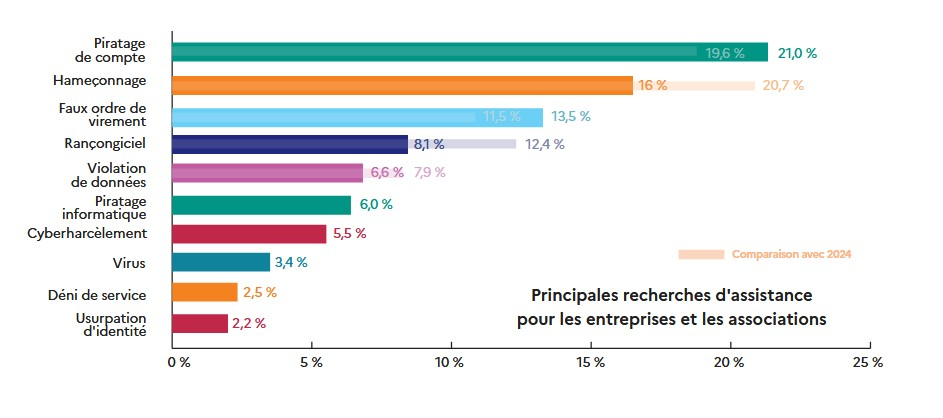
This figure says something important: cyberattacks no longer target only large groups. They also target mid-sized organisations, less well protected, often based in shared spaces where dozens of companies coexist on the same network. In a multi-tenant office building, the question of digital isolation is therefore critical.
Companies subject to strict standards, such as ISO 27001 certification, are required to have an isolated private network, even when they move into a shared space. But beyond regulatory obligations, it is a good practice that is gradually taking hold across all organisations that handle sensitive data, whether R&D, client data or contractual documents.
A purple cable on a white wall: when IT spoils everything
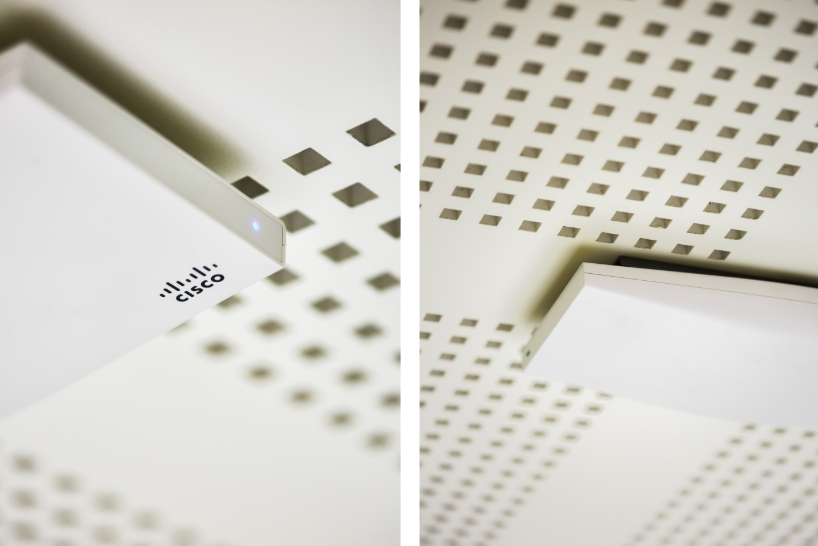
IT infrastructure is visible: the cables running along the walls, the Wi-Fi access points on full display, the video-call bars poorly fixed under the screens… All of this has a direct impact on the perceived quality of a workspace.
A purple cable against a white background in a carefully designed meeting room is a detail that says a great deal about the care taken over the whole. And the other way round, a well-integrated technical installation — discreet access points, invisible cable runs, equipment built into the furniture — contributes to the visual coherence of a space.
That is why IT must enter the conversation right from the design phase of a fit-out, and not as a last resort. The questions are technical: where should the Wi-Fi access points be positioned depending on the partition materials? How many should you plan for a given number of people and a given type of use? How do you integrate video-call equipment into rooms of different sizes? But they have concrete answers, provided you ask them at the right time.
Worth noting: some materials let the Wi-Fi signal through poorly. Plasterboard is relatively neutral. Safety glass attenuates the signal. Metal, for its part, can create a veritable Faraday cage. Three metal filing cabinets placed between an employee and the nearest Wi-Fi access point can be enough to make the connection almost non-existent in an office.
Discover the Morning Connect offering
Morning today manages more than 55 spaces, meaning more than 20,000 devices connected to the Wi-Fi network each day, more than 250 meeting rooms equipped for video calls, and more than 3,000 active network devices monitored continuously, 24/7. The average Wi-Fi speed across the spaces is 1 gigabit per second.
This infrastructure was not built in a day. It is the result of ten years of opening spaces, of problems encountered and solutions tested.
It is this accumulated experience that Morning now offers outside its own workspaces, through its Morning Connect offering: professional Wi-Fi, network security, meeting-room equipment, and aesthetic integration of the hardware. An offering designed for companies moving into new premises that want to avoid treating IT as a last-minute afterthought.
Do you have questions about the IT infrastructure of your workspace, or about what Morning Connect could bring to your fit-out project? Find out more about our offering.
Our team is available to assist you.

Download our new study
Nouveaux bureaux : ce qu'attendent les salariés
.png)


.jpg)