


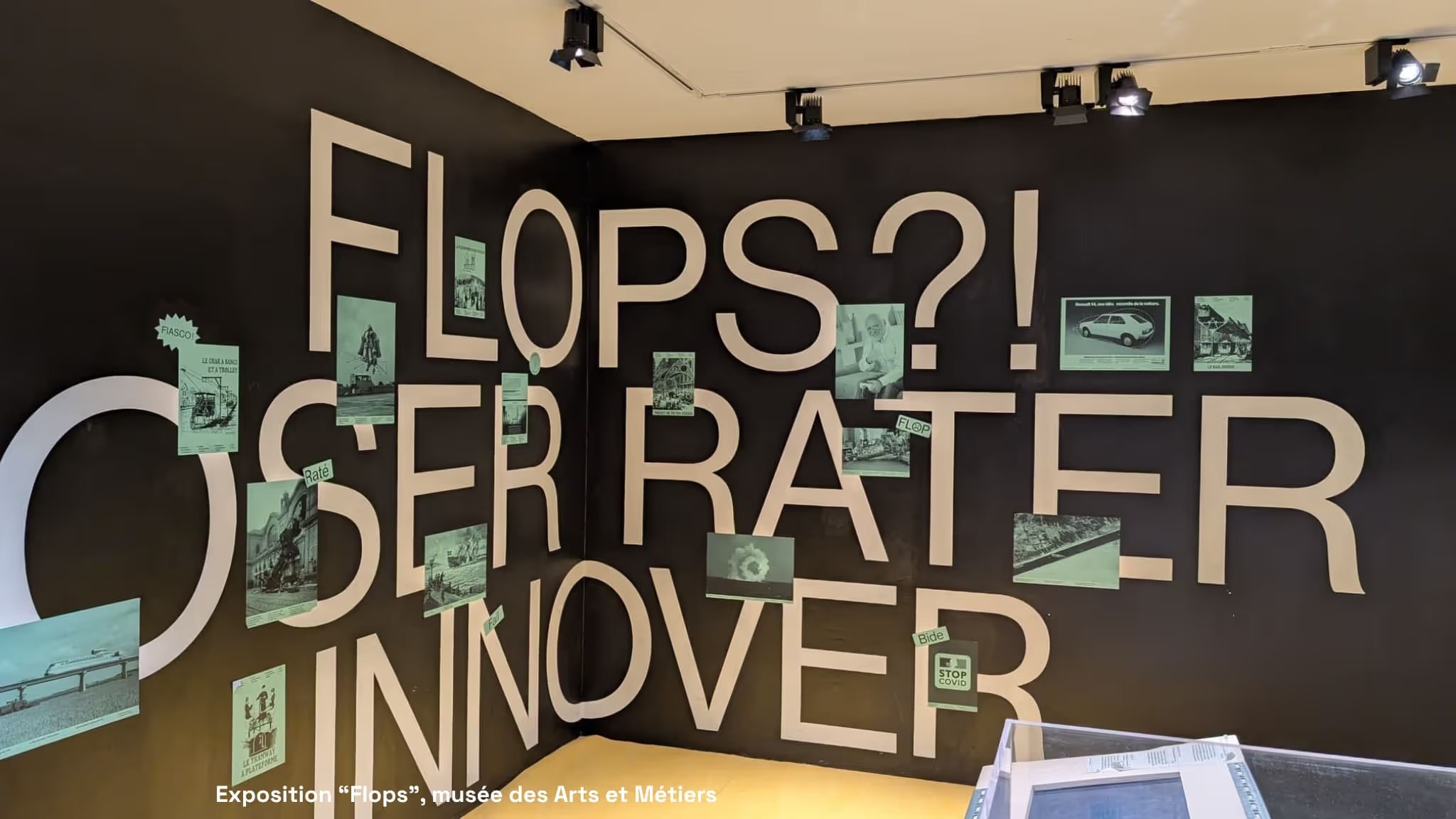
Making a mistake at work. There's an idea that sends a chill down many an employee's spine. Fear of judgement, dread of disappointing, anxiety about the fallout... What if it were precisely this fear of making mistakes that was holding back our organisations' performance?
In 2012, Google launched Project Aristotle, a study of 180 internal teams to understand what makes a "dream team". The results revealed that the number one performance factor is neither average IQ nor experience, but psychological safety.
"You need to promote a climate of psychological safety within the company: a setting in which employees are no longer afraid to take risks, a climate in which they aren't afraid to own their mistakes. Those mistakes are, in fact, essential to learning and to improving the company's processes." according to Amy Edmondson, professor of leadership and management at Harvard Business School.
Such a situation is still a long way from reality if the survey entitled "Asking for Help May Be a Privilege" is anything to go by, revealing that 59% of employees still don't dare ask for help when they get stuck on something.

1. Why are we so afraid of getting it wrong?
The psychological barriers that paralyse us
Humans aren't born with a fear of failure; it's their culture, their society, that instils it. If 59% of people would rather struggle on alone than call on a colleague, it's the result of deep conditioning.
- The cult of self-reliance: right from school, the system prizes "doing your work on your own". Asking for help ends up being seen as an admission of helplessness or a sign of weakness. This belief takes lasting hold: the good professional is supposedly the one who needs no one.
- The (irrational) fear of refusal: the brain conjures up worst-case scenarios about how the other person will react. Yet research in social psychology shows that humans are naturally inclined to help one another. In reality, the likelihood of a "no" is consistently overestimated.
- The weight of the debt: this is the law of social reciprocity. If I ask Marc for help, I "owe" him something. For many, staying self-reliant means staying free of any debt.
- The ego trap: our society has enshrined the figure of the self-made person. Individual success is prized at the expense of collective intelligence. Admitting to a slip-up then means chipping away at that image of perfection so carefully cultivated on LinkedIn.
How do you counter these barriers?
=> Let curiosity be your guide
Anne-Laure Le Cunff, a neuroscientist and author of "Petites expériences pour vivre en grand", suggests a radical approach: let curiosity be your guide rather than performance. "Accepting that not everything can be perfect makes life less stressful, which may be the key to stopping procrastinating."
You know that important task you've been putting off for weeks? There's a strong chance it's out of a fear of imperfection. A fear of not measuring up. A fear of getting it wrong. What if you allowed yourself to do it imperfectly rather than not at all?
=> Asking for help is a way of valuing others
Here's an interesting exercise: the next time a colleague asks you for help, notice your reaction. In the vast majority of cases, you'll be glad to be able to lend your expertise. Valued. Useful.
So why imagine it would be any different when you're the one asking?
Asking for help means giving the other person the satisfaction of helping a fellow human. It means building a connection. It means recognising someone's expertise and valuing it. It means drawing on collective intelligence rather than staying stuck in your corner.
It also, more prosaically, means saving precious time and avoiding reinventing the wheel. Two hours of solitary research versus two minutes talking to a colleague: it doesn't take long to do the maths.
2. The benefits of the right to make mistakes
=> At the individual level
Less stress
This constant fear of making mistakes is not without consequences for individuals. It generates chronic stress and anxiety, erodes quality of working life and drives procrastination.
Fostering learning
As soon as making a mistake becomes too risky, risk-taking disappears. You stay in your comfort zone. You reproduce existing patterns. You no longer dare to experiment, to innovate, to put forward new ideas.
This "zero mistakes" culture stands in the way of learning. How can you make progress without getting things wrong? How can you develop new skills without feeling your way? Making mistakes is a necessary stage in any learning process, whatever your age or place in the hierarchy.

=> At the collective level
Innovation/performance
At the collective level, the stakes are higher still. Without the right to make mistakes, innovation is impossible.
Google's Project Aristotle in 2012 confirmed this observation on a large scale: psychological safety is the number one factor in team performance. In other words, the highest-performing teams are those where members can voice their doubts, share their mistakes and ask for help without fear of judgement.
Daring to say what you think fosters innovation. New ideas rarely emerge from consensus and uniform thinking. They are born of debate, of experimentation, and therefore of accepting that some attempts will fail.
A horizontal culture
The most innovative companies have understood this well. They don't penalise mistakes, they turn them into raw material for collective learning. A mistake becomes a valuable signal: it shows that you are exploring new territory, pushing the boundaries, innovating.
This is where hierarchy gives way to the project. When the fear of penalty disappears, individual responsibility grows. Everyone becomes a guarantor of the group's progress, because today's failure holds the keys to tomorrow's success.
3. How do you put the right to make mistakes into practice?
Here are a few concrete ideas for transforming your company culture:
- Create "safe zones": set up talking circles or discussion groups where people can speak freely. The idea is to talk through the sticking points with no risk of it counting against you in the annual review.
- Make feedback a ritual: don't save your feedback for the year-end reviews. Practise constructive feedback after every project, whether it's a success or a failure. What did we learn? What will we do differently next time? (See also: Let's cultivate the art of feedback!)
- The project-based way of working as a safeguard: at Morning, our cross-functional organisation lets everyone become a project lead. Every project needs a leader who will set clear objectives and surround themselves with expert contributors to help them move forward throughout the mission. The leader also has to identify the experts who will help them act as a safeguard.
- Celebrate "good failures": don't shout the mistake from the rooftops, but share widely the lesson drawn from it. That's how you build a collective memory and prevent others from falling into the same trap. The approach is to analyse the failure, identify the choices and decisions that turned out to be unsuccessful, and suggest alternative routes. The aim isn't to glorify failure but to see how to use it to do better.

The pitfalls to avoid
Be careful: the right to make mistakes is not a licence to do just anything.
- Trivialising mistakes: you have to strike the right balance between allowing the right to make mistakes and flagging the risks. Employees must remain aware of the impact of their actions.
- Repeating the same mistakes: if employees don't take the impact of their mistakes seriously, they risk repeating them. And that's where the problem lies. One mistake is acceptable, even useful. The same mistake three times over points to a problem of process, training or attention.
- The absence of safeguards: some mistakes can prove costly. You need to know how to draw distinctions: allow experimentation on test projects, but keep strict validation processes for critical matters.
The companies that will perform tomorrow are those that will have understood that accepting mistakes doesn't mean lowering your standards, it means raising the level of collective intelligence within your teams.
So where to begin? Perhaps with your next meeting. What if you shared that difficulty you've been carrying around for three days? Or went to see that colleague to tell them: "I'm stuck on this, can you help me?".
Our team is available to assist you.

Download our new study
Nouveaux bureaux : ce qu'attendent les salariés
.png)

.jpg)