


At a time when environmental and social challenges are becoming ever more pressing, a new entrepreneurial model is emerging, offering an innovative and sustainable response: the permacompany.
Inspired by the principles of permaculture, this revolutionary concept sets out to reinvent the way companies work, placing ethics, the environment and human wellbeing at the heart of their activities.
Here we take a closer look at this organisational model, which may well drive many company transformations in the future. A chance to share with you an exchange with Thomas Breuzard, co-chair of B Lab France, who stresses the urgent need for a change of paradigm in the face of dwindling resources and widening inequalities.
The permacompany: when organisations draw inspiration from permaculture.
The permacompany draws on the principles of permaculture, founded on three core ethical principles: care for the earth, care for people, and fair sharing of resources. These principles guide the design and implementation of systems that aim to create harmony between humans and nature.
According to an article published on Atmosvert: "Permaculture is about working with nature rather than against it. It involves designing agricultural systems that are as diverse, stable and resilient as natural ecosystems. It's a holistic vision that brings together landscapes, plants, animals and humans in a symbiotic system."
Permaculture can be applied in a variety of contexts, from urban gardens to farms, and even in the design of communities and wider ecosystems. It aims not only to produce food sustainably, but also to create systems that are ecologically sound and economically viable.
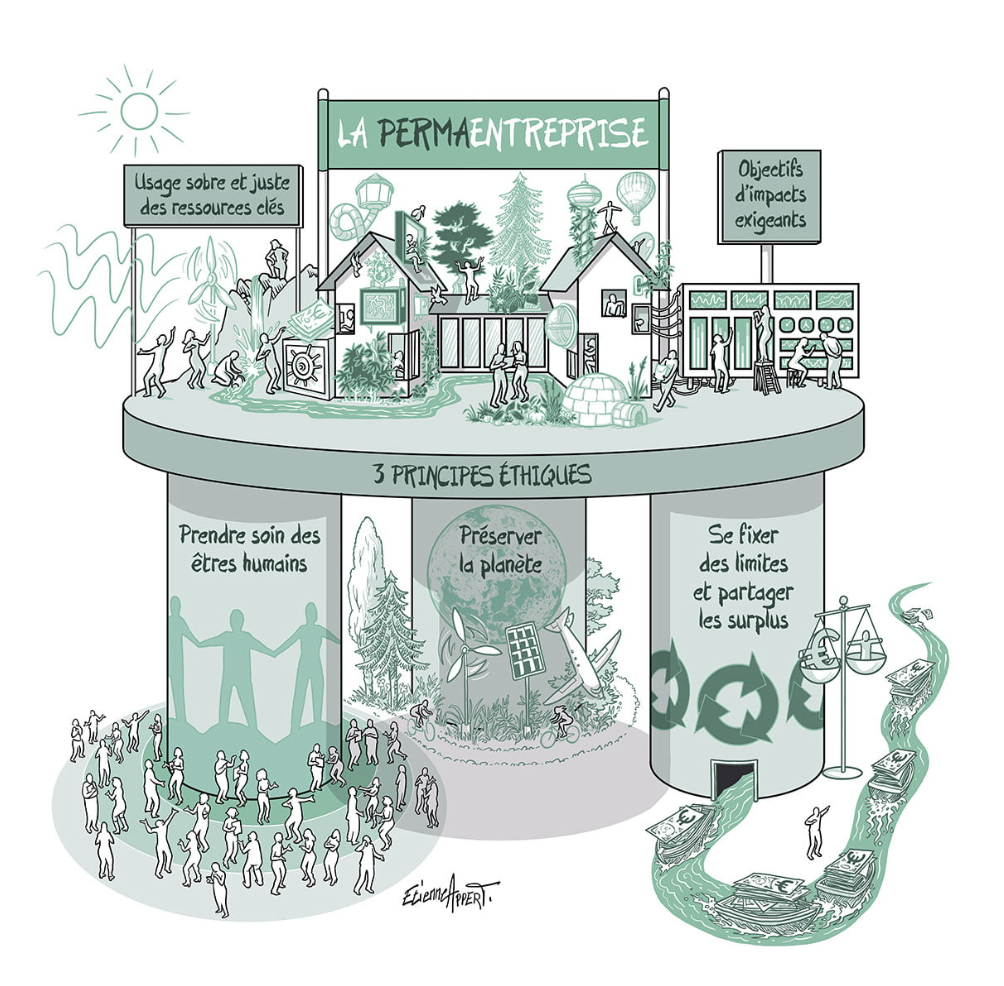
On this same model, the permacompany aims to create sustainable organisations that respect and value the environment and society. It rests on three ethical foundations:
☞ Human wellbeing : the company commits to fostering the wellbeing of its employees, clients and the wider community, by adopting fair working practices and contributing to social development.
☞ Preserving the planet : the company adopts ecological practices to minimise its impact on the environment and contribute to its preservation and regeneration.
☞ Fair distribution of resources : the company commits to a fair distribution of resources and profits, while setting limits to prevent the overconsumption and overexploitation of natural resources.
A permacompany uses resources sparingly and regeneratively — physical, human and financial resources alike — to maximise efficiency and reduce its ecological footprint.
To measure its progress towards these goals, a permacompany commits to reaching 23 precise and essential impact objectives, with full transparency to maintain the credibility of its commitment. This model seeks to be economically viable while creating value in a sustainable and ethical way, harmonising the needs of society, the economy and the environment within its strategy and operations.
Permacompany: towards a regenerative, human economy
To find out more about this new model, we spoke to Thomas Breuzard, permacompany director at Norsys and co-chair of B Lab France. To begin or continue a transformation towards the permacompany, Thomas shares with us practices to put in place, through projects that are useful to people and respectful of the living world, while remaining economically viable.

“The depletion of resources and the widening of inequalities will force organisations to transform. And given the current pace, it's best not to dawdle. The big question is: how do we go about it?
The permacompany model offers a solution: producing while regenerating the resources used. It's a genuine change of model. To do it properly, organisations need to define a purpose capable of jointly encompassing the 3 pillars of the permacompany: caring for women and men, preserving the planet, setting limits and redistributing wealth. (read the details above)
A company that applies this philosophy commits to a sparing, even regenerative, use of the resources essential to its activity. It sets itself demanding impact objectives and meets them.
At Norsys, we support our clients with their digital practices - while integrating the principles of the permacompany, notably when it comes to profit-sharing and employee savings:
⇒ The redistribution of the wealth created is now proportional to working time and no longer indexed to salary,
⇒ Employees have decided by referendum to move the company savings plan towards funds that limit the pursuit of financial performance,
⇒ These funds were selected on the basis of their strong contribution to financing the players in the ecological transition.
A wholesale transformation doesn't happen without considerable effort. Even so, it offers many advantages, because permacompanies will attract plenty of talent and new clients. Consumers are increasingly committed and invitations to tender increasingly demanding. Another strong point: your R&D will be one step ahead of your competitors by anticipating the standards to come. So you may as well get going now.”
What are the advantages of the permacompany?
The permacompany, a concept only just emerging, is set to radically shake up traditional business models. Yet this innovative approach offers a host of advantages, notably in terms of economic and financial sustainability, employee engagement and wellbeing, and the strengthening of relationships with stakeholders.
☞ Economic and financial sustainability :
Adopting a permacompany approach contributes significantly to the economic and financial sustainability of organisations. By placing the emphasis on environmentally friendly and socially responsible practices, these companies not only attract a clientele that is conscious of ecological issues, but also foster more efficient management of resources. This translates into reduced costs over the long term and greater resilience in the face of economic and environmental crises, thereby ensuring stability and sustainable growth.
☞ Employee engagement and wellbeing :
The permacompany places employee wellbeing and engagement at the heart of its concerns. By valuing ethical working conditions and a work-life balance, and by promoting a healthy, stimulating work environment, it fosters a high level of satisfaction and motivation among its people. This heightened engagement is reflected in the quality of work, innovation and productivity, contributing to the overall success of the company.
☞ Relationships with stakeholders :
The principles of the permacompany strengthen relationships with all stakeholders, whether clients, suppliers, partners or the local community. By committing to values of sustainability, fairness and social responsibility, companies weave bonds of trust and mutual respect. This approach fosters the creation of strong, lasting networks, essential for developing fruitful collaborations and for the continuous improvement of business practices.
Transforming into a permacompany brings a multitude of advantages, from attracting talent and clients to significant competitive advantages, all while preparing for the challenges and standards of tomorrow. This business model embodies not only a solid commercial strategy but also a commitment to a more sustainable and responsible future.
******
You now know just about everything there is to know about the permacompany. If you have ideas to enrich the subject, do share them with us in the comments field below!
***
☞ Can your workspace be more responsible?
☞ Eco-designed furniture, by Morning.
☞ Building works: 4 responsible alternatives to conventional materials
Our team is available to assist you.

Download our new study
Nouveaux bureaux : ce qu'attendent les salariés
.png)


.jpg)