

IT manager, what's that all about?
"The wifi's playing up, what am I supposed to do?" You've all heard this line from a member of your family at some point. But you've certainly never heard it as often as Mathias, the Network Infrastructure manager at Morning Coworking (who will be all the more irritated because it's "wifi" as a protocol, not something you say "the" in front of in French). If you can run into a few problems with a single router, imagine it on the scale of twenty or so coworking spaces. It's a whole different kettle of fish, as they say. So we put a few questions to Mathias about this role, which is crucial to running a coworking space.
Can you introduce yourself?
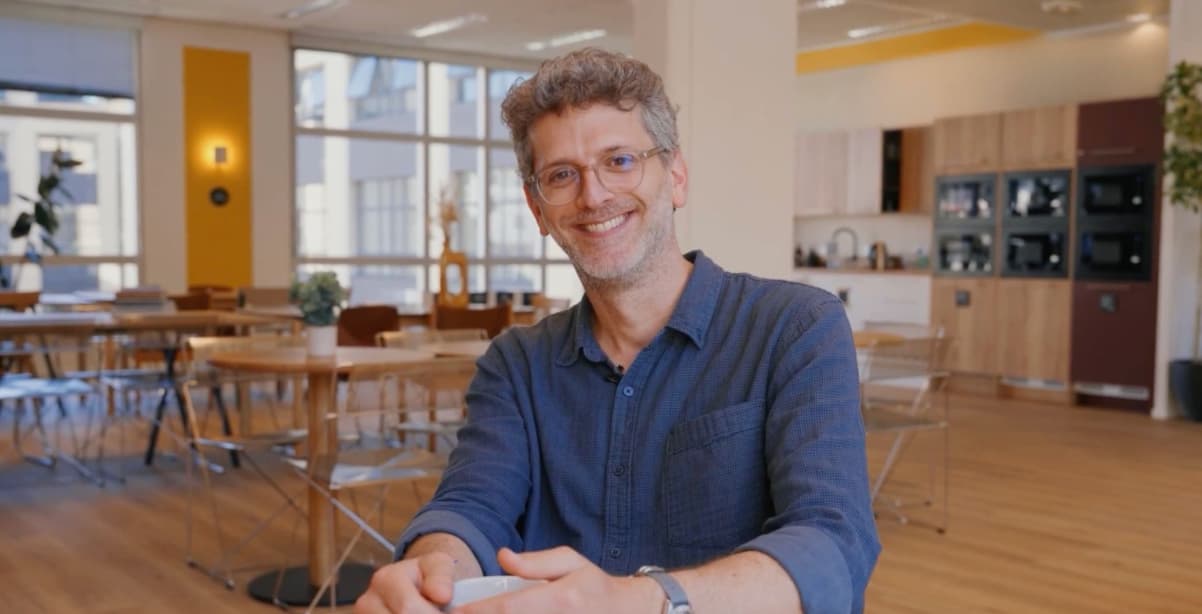
M: "Hi, I'm Mathias, I'm 29 and I've been working for Morning Coworking for 3 years. I'm in charge of the whole network infrastructure across the various Morning Coworking spaces."
What does your role involve?
M: "My main job is to make sure everyone has a reliable, secure and fast internet connection.
So we mainly handle the opening of spaces. For that, we work from a floor plan to position the wifi access points, then we configure all the equipment so that everything works well for all our future users, the coworkers.
Then we respond to the needs of our clients who have specific network requirements. For example, when we host a large group, we often have to interconnect our network with their head office: we create (virtually) a tunnel between our spaces so that the employees feel at our place just as they would at their own.
And finally, we remind everyone day in, day out that in French it's "le wifi", not "la wifi"."

What does a typical day look like for you?
M: "It's very varied, it really depends on the period and on the space openings under way. I'm actually very happy to give that answer to this question!
One morning I can find myself negotiating with the CIO (Chief Information Officer) of a multinational, and in the afternoon I'll have my hands in a patching cabinet moving my RJ45 cables around. Ideally in that order. After that, we can be called on to scan a particular part of a space to find stray signals that are bothering people on wifi, or to set up special configurations for a company that wants to filter its employees' access to certain sites."
Do you tend to work as a team or on your own?
M: "We work as a team with Antoine, who first spent 3 years with us on a work-study contract, then became an Engineer and has just joined me. We're recruiting, but talent is hard to come by in this field. Between us we divide up the tasks and work in project-based mode. Every Monday, we start with a meeting to review and create new tasks, then we divide them up sensibly.
We go from leading on one project to carrying out someone else's on another; it's fascinating, it gives you an overall view and, as a result, it motivates everyone."
What path did you take to get there?
M: "I did a two-year technical diploma and an engineering school; it's the classic, easy route because it avoids the preparatory classes. Ideal when you know what you want to do. The preparatory classes can be a way of putting off the career choice for 2 years."

What do you enjoy most about your job?
M: "The way it's evolved! We started out with makeshift setups; we used to assemble Liveboxes in a cellar (literally) with an algorithm that sent users to one or the other depending on how much bandwidth each had left.
Today we have a "network infra" worthy of the big corporations, on technologies we were among the first to adopt and that are now becoming the norm.
And also, since this job can largely be done remotely, I can work remotely - I live part-time in Annecy - which lets me alternate between city life and life at the foot of the mountains and the lake."
What obstacles can you come across?
M: "Wifi is a very complex thing; these signals are subject to a huge amount of interference. So it's really complicated to position the access points well during the study; you have to take proper account of the material choices made by the works/decoration team and keep up with any changes. Once it's all in place, you also have to watch out for new sources of interference, such as a new neighbour, equipment installed on our premises, or anything else."

What qualities/skills do you need to have or develop to do this job?
M: "Curiosity, a solid base of technical knowledge, and being good with people. Networking is perhaps one of the "disciplines" of IT with the most human contact, so that's an important aspect; we're in contact with almost all the users who come into our spaces."
Do you have any advice for someone who'd like to get started?
M: "Go for it! The internet has a bright future ahead of it, it's constantly evolving and there are loads of jobs in this field - security, infra, more building/works-related aspects. And above all, apply to Morning once you're ready!"
A rather fine conclusion that also serves as a segue, since I'm taking the liberty of leaving this link right here, quietly, in case you'd like to apply to work with Mathias! And come this way if you'd like to discover the Morning Manager role.
Our team is available to assist you.

Download our new study
Nouveaux bureaux : ce qu'attendent les salariés
.png)
.jpg)