

73% of employees in France can work remotely, and 80% say it will be a decisive factor in accepting their next job. In company agreements, the “standard” rhythm is settling around a little more than 2 days per week, and 85% of remote workers actually stick to this ratio.
The question, then, is no longer about “trying out” remote work, but about making it work well over the long term. The main HR challenges of the coming years will be team engagement and cohesion at a distance.
To get a clearer picture, Fleex carried out the Un air de Remote survey of 229 remote workers, looking at their habits, what makes them effective and what motivates them. Drawing on this study, we have identified 5 points to watch, simple and actionable, to better support your teams working remotely.
Tip 1: Adapt flexibility to your team’s realities
The first step is to assess how compatible each of your roles and activities is with remote work. Some functions lend themselves to it little or not at all, while others fit perfectly with a hybrid model, or even with 100% remote work.
It is at team level that setting the remote-work rhythm makes the most sense. Each team knows its own constraints and needs for on-site collaboration, the volume of tasks that can be done remotely, and its rituals and key moments requiring a physical presence.
This is where the number of remote-work days, how they are spread across the week and how they fit around collective time can be pinned down. Take care, however, to avoid overly disparate rhythms within a single team, which would make coordination harder.
Among the deciding factors that come up again and again, the Fleex study reveals a fairly logical finding: the further away people live, the more they work remotely. More precisely, respondents whose median commute is 35 minutes work remotely 1 to 2 days a week. Those whose median commute is 45 minutes work remotely between 3 and 4 days a week.
There may also be adjustments for medical appointments, disability, or occasional family commitments. The important thing is to formalise these exceptions collectively rather than handling them case by case behind closed doors.
Tip 2: Build a culture of trust, not control
Moving from in-person to remote can bring about a shift in the relationship between a manager and their team. Un Air de remote reveals that remote workers’ main requests are not about how work is organised (68% of respondents say they are more productive at home and 62% more creative) but about managerial mistrust. Among the grievances mentioned, here are a few telling quotes: “less micro-management”, “stop being suspicious of remote work”, “don’t single out those who work remotely”.
This tension shows up in how remote work is perceived across the hierarchy. While employees give it a score of 8.5/10, managers rate it 8/10 and senior leaders 7.7/10. The Fleex team offers an explanation: some managers may experience remote work as an obstacle to their recognition. Is it not hard to “prove” you are running your team well when everyone is working outside the walls?
A worrying side effect: 25% of remote workers feel they have to do more to demonstrate that they are really working. A clear signal that it is time to strengthen the climate of trust, rather than adding further layers of control.
A real challenge for managers, who have to shift their frame of reference while avoiding the opposite excess of “do as you please, you’re grown-ups”. This flexibility does not mean laxity. It is therefore essential to define clear windows of availability (e.g. reachable from 9.30am to 6pm), when everyone should be able to connect and communicate, without envisaging minute-by-minute surveillance.
Tip 3: Equip the home (like an office)
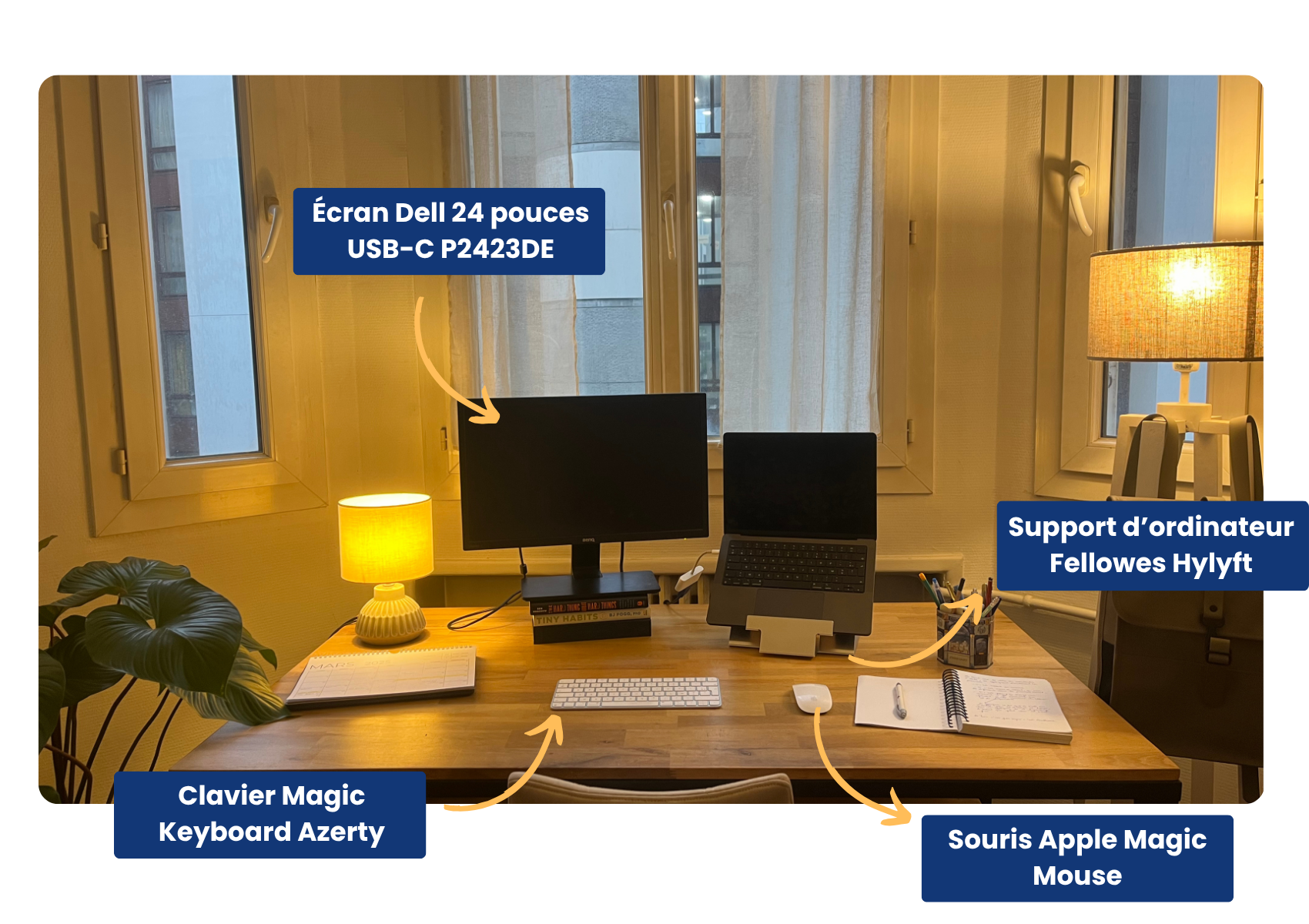
Sustainable remote work starts first and foremost with a suitable workstation. Yet, according to the Fleex study, ergonomics at home score only 3.3/5 on average, and 22% of respondents would have liked more support with equipment. Echoing these figures, data from Santé publique France reveals that lower-back pain affects 9% of employees working remotely full time, compared with 5% in hybrid working.
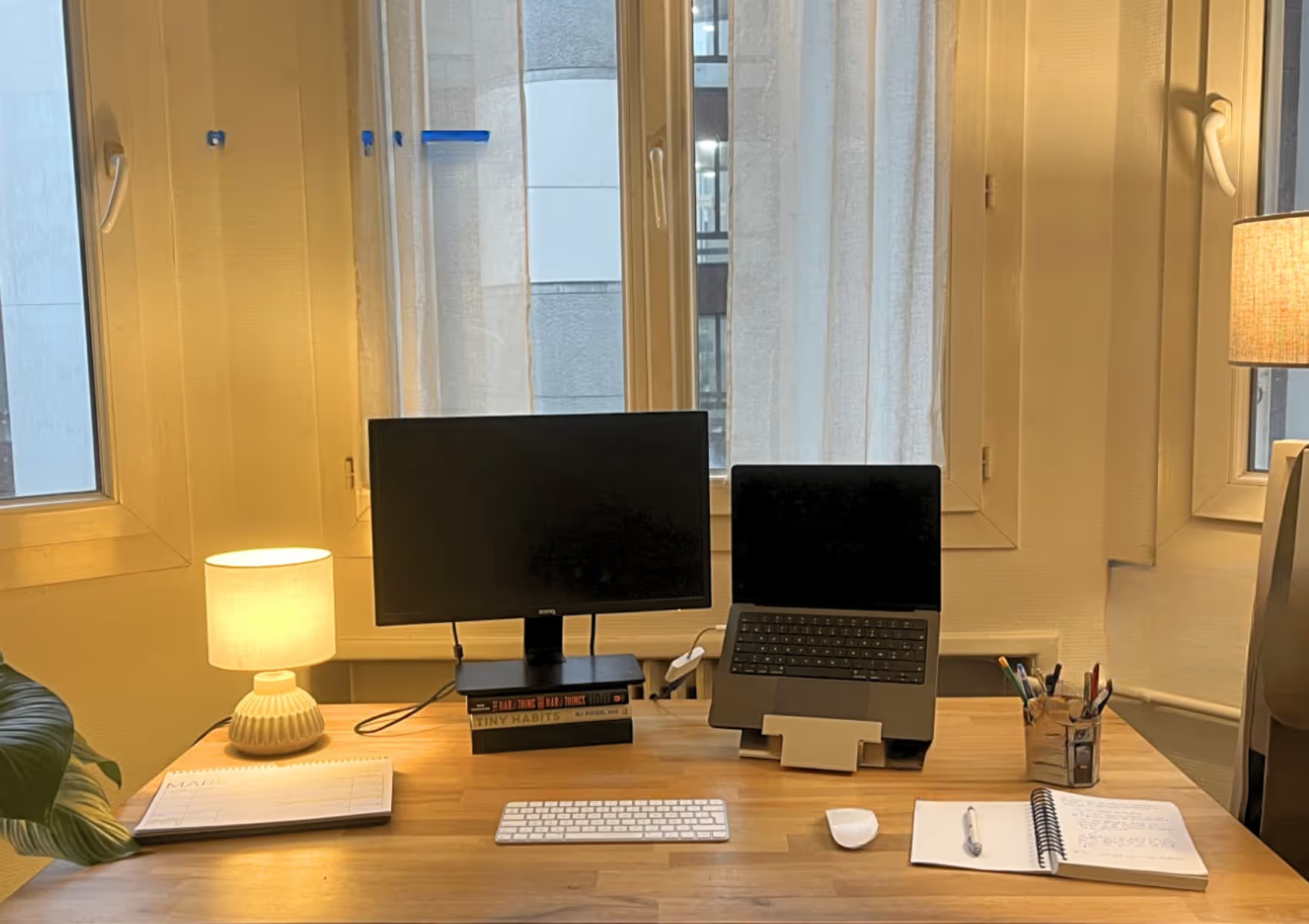
To improve the situation quickly, three pieces of equipment make the difference. The second screen comes top: it limits poor posture, makes multitasking easier and gives the feeling of having a proper workstation. Next, an ergonomic chair — around €400 on average — is a worthwhile investment over several years, with compact models available for small spaces. Finally, the essential accessories round things off: a stand to raise the screen (to eye level), a headset for video calls, an ergonomic mouse and an external keyboard for good posture.
One last point worth stressing: provide equipment on loan (rather than a purchase by the employee that is then reimbursed), avoid asking for proof of home insurance, and set out the arrangements for returning it if someone leaves, with a renewal cycle every 3 to 5 years.
Tip 4: Give thought to remote team rituals
50% of remote workers have no ritual to foster team cohesion at a distance. This is the critical blind spot of remote work. Without structured rituals, your teams gradually become isolated, the sense of belonging erodes, and turnover rises. It is therefore important to establish rituals to keep the collective alive. Among the 50% of respondents who have introduced rituals, here are the formats that work:
Agile meetings: daily or weekly team check-ins over video call. An example routine: from 9.30am to 9.45am, everyone gathers for a quick check-in. Each person explains what they are working on and any difficulties. It is the equivalent of what would be said spontaneously by the coffee machine, but in an organised way.
Virtual coffees: slots with no agenda for a 15-minute chat. This might be between two people who are not on the same team. It is an excellent way to break down silos and create cross-functional connections within the organisation.
Fun activities: organising online games on a Friday afternoon every fortnight, for example.
Beware, though: taking part must remain voluntary so as not to slip into forced team-building, which becomes counterproductive.
Tip 5: Offer alternatives to the home
Fortunately, remote work does not always mean “home office”, because not every home lends itself to ideal working days: flats that are too small, no dedicated room, a noisy environment (children, flatmates, neighbours, building works), and so on.
Working in third places not only remedies these nuisances but also lets employees break away from the home environment, keep a “work” routine that gives the day structure, or enjoy a proper ergonomic workstation (often better equipped than at home). What is more, this practice of coworking within a single company can rebuild the collective and maintain flexibility within your team, while recreating local micro-communities.
For the company, the benefits are just as numerous. Coworking widens the recruitment pool beyond the company’s immediate area, retains talent who move away for personal reasons and reduces property costs at the main head office.
Remote work is no longer a problem to solve, it’s a balance to orchestrate
80% of employees consider remote work a decisive factor for their next job. 76% do it primarily to save commuting time (3 to 4 hours a week on average). 68% feel more productive at a distance.
The 5 levers shared here will help managers organise remote work flexibly within their team. Establish trust above all (moving from “how many hours?” to “what results?”). Introduce rituals to keep the connection alive. Equip your remote workers (€400 to get started is an investment, not a cost). Adapt flexibility to the realities on the ground and to your company culture. Offer alternatives such as coworking for those who cannot work from a home office in the best conditions.
As the Fleex study puts it: “Work is becoming a choreography made up of choices, adjustments, listening and trust. The organisations that succeed will not be those that come down on the side of ‘all office’ or ‘all remote’, but those that know how to give meaning to every presence.”
➡️ Download Fleex’s full study “Un air de remote”
Our team is available to assist you.

Download our new study
Nouveaux bureaux : ce qu'attendent les salariés
.png)

.jpg)