

The word network (from the Latin retiolus, “little net”, a diminutive of retis, “net”) refers, in its strictest sense, to an interweaving of threads and lines.
In technical fields (such as computing and telecommunications), it takes on a broader meaning to denote “a set of nodes (or hubs) linked together by connections (or channels) in order to promote the exchange of data and information, to share resources, to transport matter or energy. The nodes may have more or less complex functions of distribution, concentration and enrichment, while the channels perform a transport function.”
In this sense, operating as a network presupposes the upkeep, the enrichment and the linking of each of its points of contact so as to make the whole stronger and more effective.
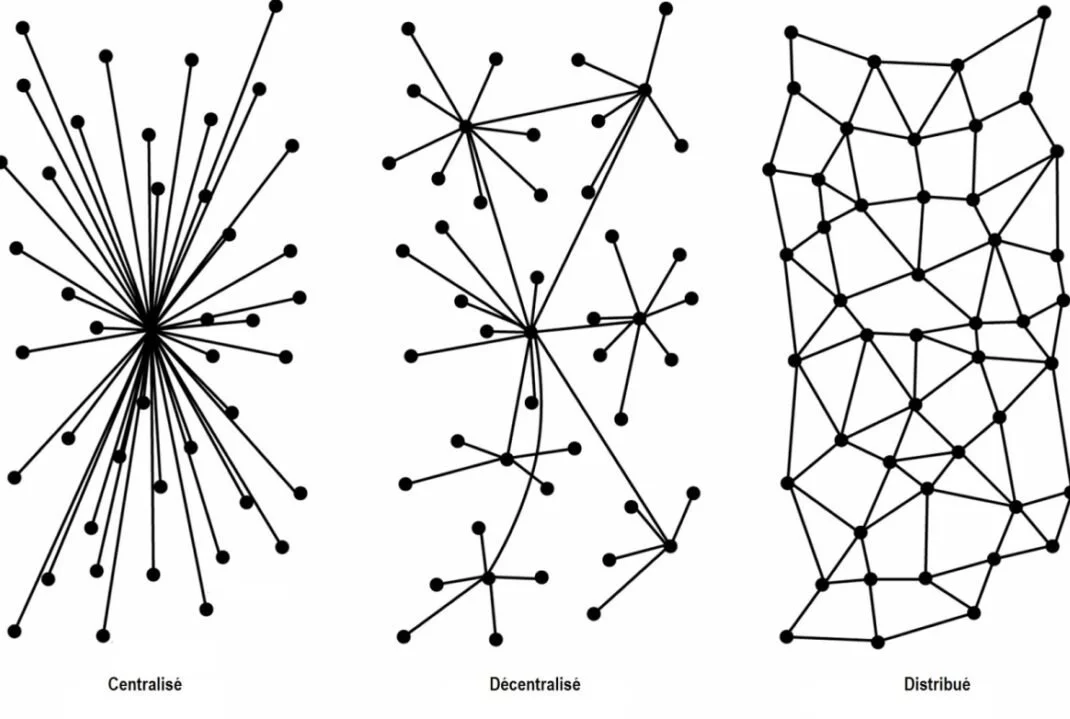
The specialist literature identifies three types of computer-network architecture:
- Centralised network: In the case of a centralised network, we have one large central node linking all the subsidiary nodes. So to move from a node A to a node B, you must always pass through the centre of the network. The centre is therefore a single point of contact for sharing information.
- Decentralised network: As for the decentralised network, we have several central nodes, each with its own group of subsidiary nodes. Thanks to this plurality of centres, if one particular central node fails, sharing information remains possible via the other groups of nodes.
- Distributed network: The distributed network is the decentralised network taken to the extreme. It avoids any centralisation altogether. The core idea of the distributed network lies in the concept that every node stands on an equal footing when it comes to sharing information, which can take any route to reach any destination.
Following this typology, in this article we invite you to look back at three types of organisation and their corresponding workspaces.
The centralised model: the canonical form of management and design
The centralised model is the initial stage in the organisation of work and the design of workspaces. This model, criticised for its autocratic and strongly hierarchical character, appears as the dominant form at the turn of the 20th century, with the intensification of society's processes of industrialisation and urbanisation.
Vertical management and technical control: constrain and monitor
It was in this period that Frederick Winslow Taylor, in an effort to guarantee optimal production in businesses, proposed creating the role of the organising engineer to direct all activity. This figure was tasked with defining, for each worker, the “right task” (which maximises output) and the “right pay” (which minimises costs). Taylorism was born: the idea of vertical, strongly hierarchical management, together with a fragmented division of labour for each employee.
Taylor would elevate this strictly management-side viewpoint into a scientific postulate, in that it leads to tracking and measuring work activity with great rigour. In Taylor's view, man is lazy and self-interested; and so, to secure his participation, he must be constrained and monitored.
This model of managing the workforce was taken up by Henry Ford, for whom the work carried out in the company should express the technical vision of the engineer-manager. The technical and scientific conception of the organisation of work would ultimately contribute to the standardisation of tasks and, subsequently, to the development of mass industry.
According to the Taylorist-Fordist model of vertical management, which marks the turn of the 20th century, the organisation of work aims for immediate output efficiency at the expense of workers' autonomy, and even of their freedom. The workers' labour is an instrument whose efficiency must be easily monitored.
The Taylorist workspace and the partitioned office
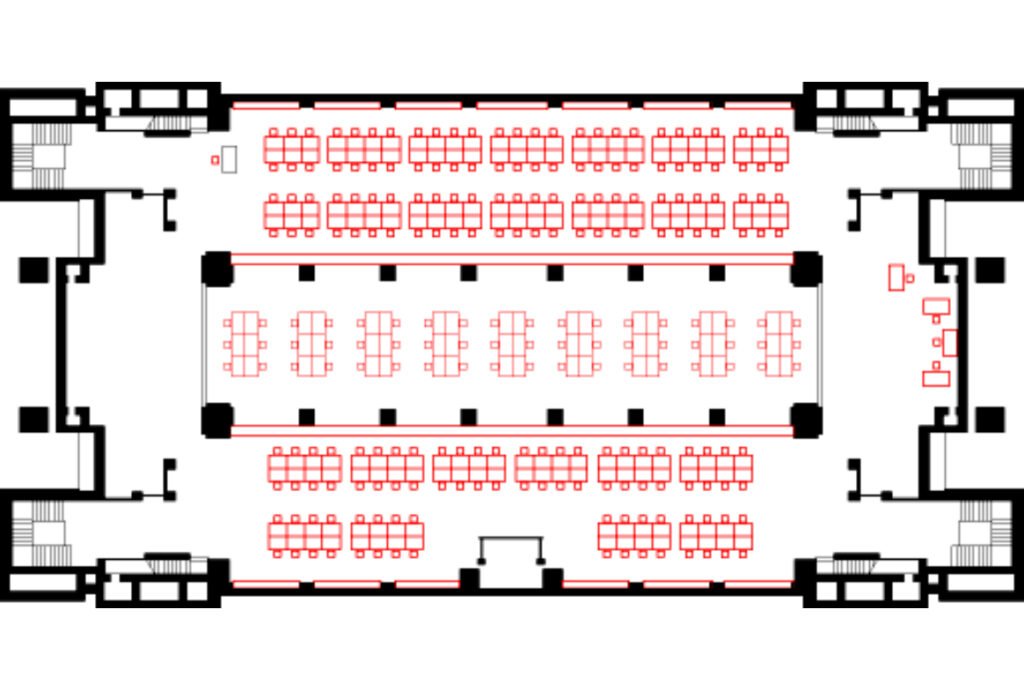
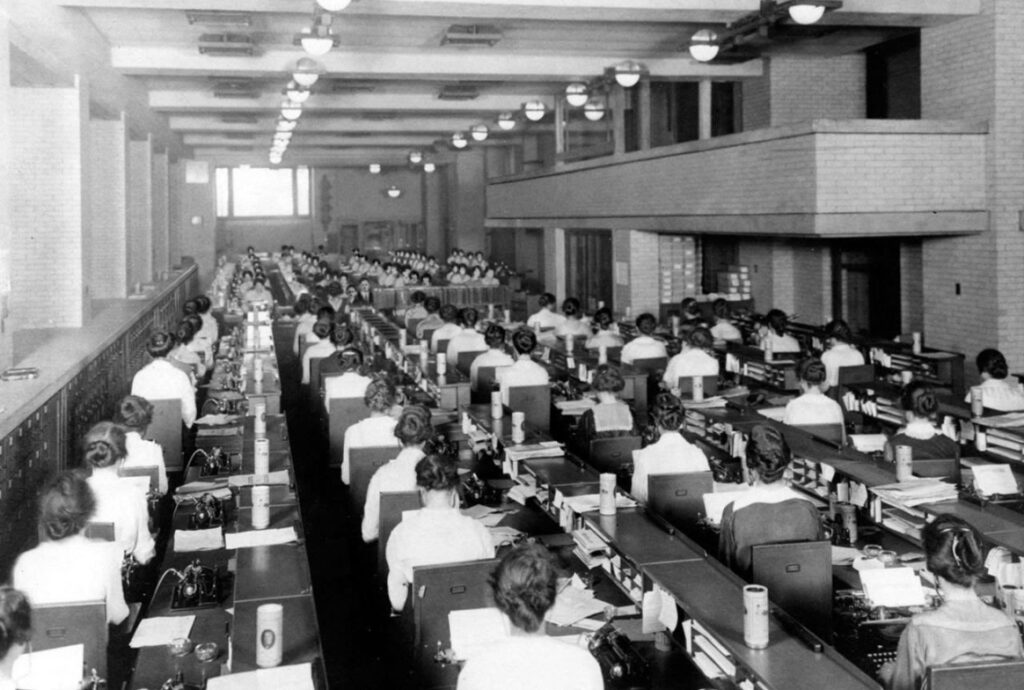
From industrial sites to workspaces with partitioned offices, the layout of the Taylorist space largely answers the aim of controlling employees, echoing the vertical, technicist style of management. Various layout techniques sought to encourage this monitoring by managers, in a – often unsuccessful – quest for productivity.
This approach took shape in the layout of large open floors where every workstation was observable by a foreman or manager from any point in the workspace. These workstations were grouped by the task performed and by the employees' skills. The aim was to promote the flow of production of industrial goods or the circulation of documents. In this sense, the layout of the space followed the logic of the assembly line and of production-line work.
Moreover, the Taylorist-inspired workspace had the advantage of fitting a greater number of workstations per unit of usable office space. It is worth remembering, however, that management always kept its own individual offices. This organisation follows our analogy of the centralised network, with management forming the company's decision-making centre.
The decentralised model: a response to employees' aspirations for autonomy
The decentralised model emerged in the wake of the social movements of the 1960s and 1970s, which sparked a surge of autonomy and participation among employees. At first, this new model developed initially in Japan and Europe. It was only later that its adoption spread to the US, with less success, for reasons that were in particular socio-cultural and economic.
Participative management and democratic governance: a humanist step forward
In the 1960s, many more people-centred management models began to flourish. Paradoxically, the period was one of the rationalisation of tasks, but also of the mobilisation of “human resources”, which came to inspire companies' recruitment and internal management processes.
It was the car industry that drove the main innovations: empowering teams, simplifying the chain of command, continuously optimising processes (known as kaizen), streamlining decision-making processes. In Japan, Toyotism (a term referring to the practices of the Japanese company Toyota) focuses on the collective and on making each individual accountable in diagnosing and solving problems. The flexibility of Toyotism then contrasted with the rigidity of Taylorism-Fordism and would gradually spread to other fields.
In Europe, the loosening of social mores and the hope for a more egalitarian and peaceful society (in the aftermath of the Second World War) pushed companies to make certain concessions to employees. The model of co-management emerged as a fairer form of management, more respectful of people and far less vertical than the previous system. Germany took up the mantle of this democratic governance and championed an organisation in which all those affected by a decision should be able to take part in it. This translated into internal bodies representing employees and a significant say in decisions alongside directors and shareholders.
The bürolandschaft workspace and other experimental models
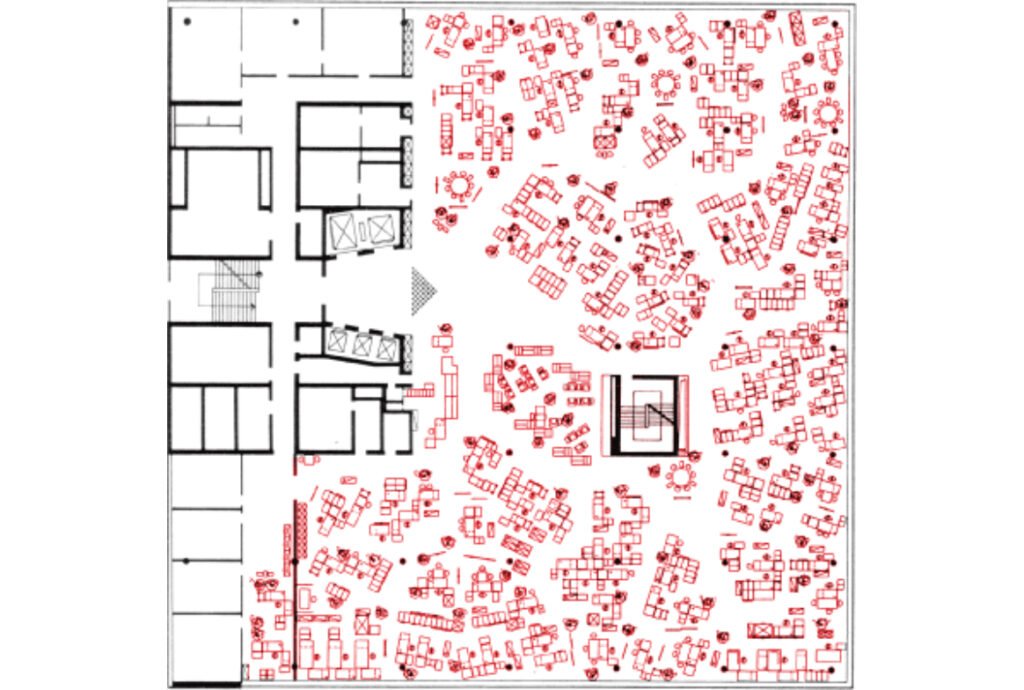
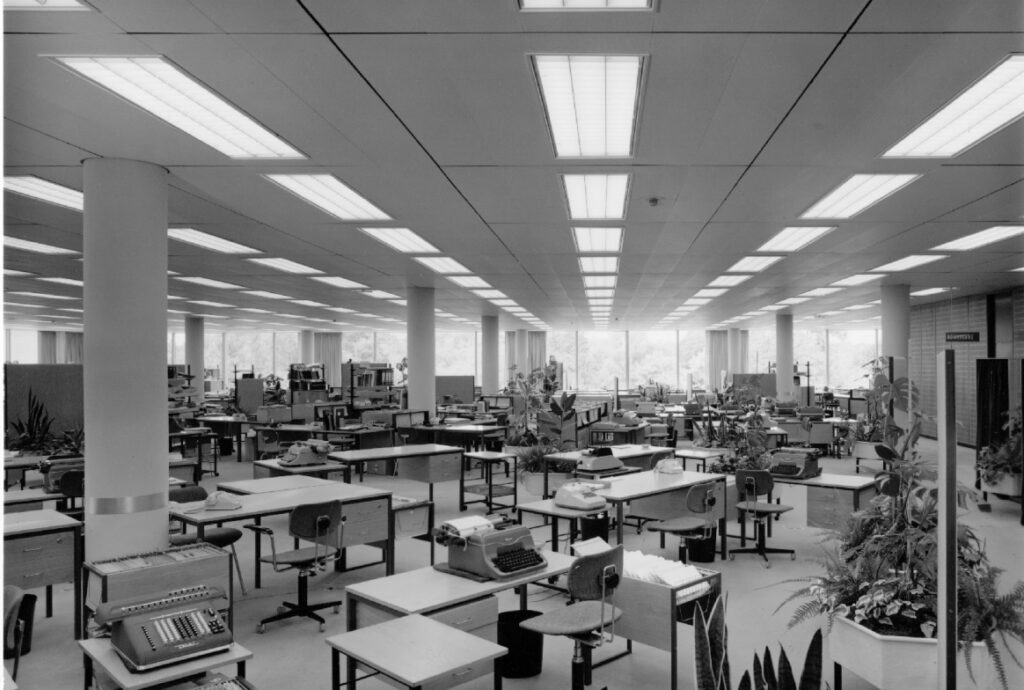
It was also on the other side of the Rhine, and driven by these experiments in democratic and more humane governance, that a very particular type of workspace layout developed, known as bürolandschaft (the German term for “office landscaping”). Regarded as the first major reinvention of the office since the rise of Taylorism (50 years earlier), this innovation aimed to break the rigid, inefficient structures of bureaucratic organisations through a spatial arrangement of the office geared to employees' specific needs.
In 1958, the brothers Eberhard and Wolfgang Schnelle set up a consultancy group with the aim of designing offices according to this philosophy. This new ambition changed the status quo: the uniform rows of workstations gave way to a more organic, natural plan.
With the Schnelle brothers' bürolandschaft, managers left their offices to join the open floors with the other employees. The spaces were separated by plants and other greenery. Temporary, movable partitions were installed to meet teams' occasional needs. Following our network analogy once again, the workspace at that point answered a logic of decentralisation.
The distributed model: the new order of work organisation in the 21st century
The distributed model echoes the organisation of work in the 21st century. Consolidated over the course of the 2000s with the growing computerisation of jobs, it also benefits from the large-scale spread of digital tools and social networks. At this stage, the emphasis is on the agility and flexibility of structures and their various components. Such innovations increase its horizontality and erase the hierarchical levels.
Liberated management and evolving governance: shared governance
Today, management has to respond to many changes: employees' aspirations for greater autonomy and flexibility, the blurring of the boundaries between the professional and personal spheres, permanent technological innovation. To keep pace, organisations must remove hierarchies as far as possible and promote exchanges between people within the office, so as to make their communication easier, both outside and within the workspace.
Horizontal management models are emerging. Thus, the liberated company (championed by Isaac Getz) and evolving governance (advocated by Frédéric Laloux) bring to light new decision-making processes, better suited to employees' needs, guaranteeing in particular their involvement in decisions and participation. In these models, the manager's role is almost non-existent and each team member is responsible for their own role. Everyone works to reach their objective in full autonomy and in collaboration with their department or team.
With project-based working, teams communicate with one another freely without going through a higher hierarchical body. Every employee has an overall view of the company's strategy and can add the contribution of their own project to the collective venture.
Shared workspaces and coworking
It is in this context that the new workspaces as we know them today are developing, such as third places, shared offices and coworking spaces. When the world of work is always connected and there are many ways of working (from on-site to nomadic), the different places of work must, in turn, adapt and seek to accommodate every possible use.
More than a mere place of work, these spaces are where a community comes together, a place of sharing, a flexible place suited to different uses and, above all, a network. And this in a double sense: the workspace is physically organised so that everyone has the same importance and the same weight in the company, and also because it is in these spaces that the famous networking takes place – that lasting link between people and companies to build mutually beneficial relationships.
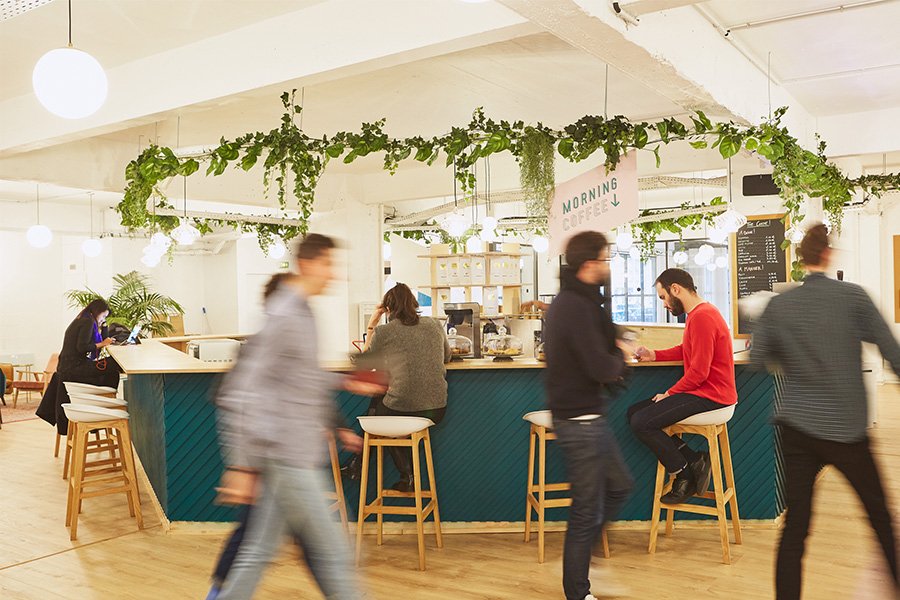
Always dynamic and connected on a global scale, the workspace-as-network has been part of the reality of businesses for at least a decade, with the intensification of the computerisation of our work activities, the emergence of new ways of working and the rise of shared offices and coworking.
First you connect people inside the workplace, then you connect the organisations, then you connect the world. That is where we now stand because, today, the new workspaces are at the cutting edge in this respect and are themselves becoming genuine networks.
Whether through a suitable layout, horizontal organisational structures, agile methods or collaborative tools, meeting and exchange between peers are at the heart of these innovative workspaces.
The company is not a fixed and monotonous institution; its types of organisation vary and, with them, employees' ways of working as well as the place of work. From vertical management to shared workspaces and coworking, the future looks increasingly distributed and atomic!
Our team is available to assist you.

Download our new study
Nouveaux bureaux : ce qu'attendent les salariés
.png)

.jpg)