


Every day, Morning's HR team works to establish a culture built on trust and the collective. This "general policy" shapes our entire organisation: project-based working and peer-to-peer learning in particular, but also our pay policy.
Today, the focus is on collective pay and the no-negotiation of salaries. Every year, we make a point of reworking our pay system, on the one hand to improve it, but also to ensure it more closely reflects economic reality (both the employees' and the company's). These various practices echo the new European pay transparency standards that will have to be implemented by 2026.
The 2024 version of our pay-rise system has once again undergone a few changes, shared with all the teams very recently. In the spotlight: raising the pay of all employees and the drive to reduce the gaps in rises between the highest and the lowest salaries. Mélanie Nabucet (Morning HR) tells us all about it.
Whenever possible, raise 100% of employees' pay and favour the collective
Every year, we do everything we can to raise 100% of employees' pay, as long as the company's profitability allows it. It's worth repeating: profitability and payroll are closely linked. You only have to work out the impact of a 1% increase in payroll on the company's profitability to see just how significant it is.
With this reality in mind, we strive to guarantee a pay rise for all employees, if and only if the company creates value. This value, created together, is redistributed through the rises. Conversely, if there is no profitability, then there will be no rises. As a result, the budgets set each year will depend on the profitability in year N-1 and on the targets set for the 5 years ahead. Among the economic parameters taken into account is the inflation rate. The result: we propose an overall pay-rise budget representing 4 % of payroll.
☞ An overall budget split between the collective and the individual :
The overall pay-rise budget is then split into 2 sub-budgets: the collective one (70%) and the individual one (30%). The collective budget is larger because we consider that it is to the team that we owe the company's success. That said, the individual budget makes it possible to carry out the necessary adjustments, in view of each person's involvement and the harmonisation of the salaries we pay.
☞ The collective rise:
In 2022, we adopted an approach tied to our sector. We created a pay-rise index based on our profitability (again and always), the consumer price inflation rate and the rate of increase in rents. This choice — tied to our activity — allows us to keep creating value without losing sight of our financial balance.
In 2023, we kept this index while noting a decline. Two years earlier, a collective rise of 1.80% tied to the inflation rate seemed to us to maintain a balanced system. However, the crisis and the war caused inflation to jump to 5%. We hadn't anticipated such a large increase in payroll, which, added to the individual rises, exceeded our budget forecasts.
Faced with this challenge, our commitment remained firm. To sustain the general rise without sacrificing the company's performance or profitability, we make our pay-rise system evolve every year.
☞ Individual rises:
If the collective rise doesn't fully meet the criteria, the individual rise makes it possible to adjust whatever needs adjusting. These adjustments are made in line with individual assessments and the team-by-team scales, without negotiation, in order to preserve balance and fairness.
To guide and/or validate our decisions, we called on Figures, a salary-management platform that aggregates the salaries of many companies, sectors, roles, and so on. This data allows us to get a clear picture of the amounts paid by sector and by role, according to a given market.
The coordinator plays an essential role in awarding, or not, an individual rise based on a tailored assessment grid and the salary scale, to guarantee a fair distribution with no room for negotiation. This rise is not automatic and does not depend solely on meeting individual targets, but rather on the overall assessment of involvement and on the comparison with the salaries of the other team members.
What's new in 2024: narrowing the gaps and communicating better
This year, our objective was twofold: to keep favouring the collective, and to ensure a fairer distribution of rises, in particular by taking salary into account.
To achieve this, we introduced a system of salary bands to redistribute the collective rise. The formula devised allocates a share of the collective rise while taking each person's salary bracket into account. To achieve greater fairness, the amount of the rise is inversely proportional to the salary brackets. This way, lower-earning employees benefit from a higher percentage rise.
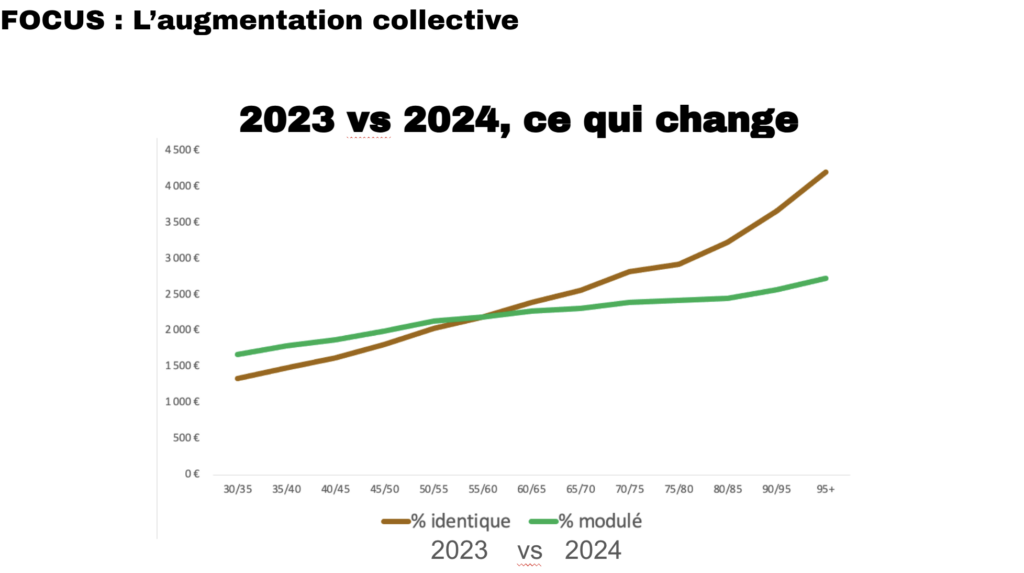
As for individual rises, they are now possible from the first year - the eligibility condition in 2023 was to have at least 2 years' service - and we have removed the €325 seniority supplement that had been put in place to reward employees' loyalty and commitment. This supplement is now replaced by additional days off and, in its place, we have introduced a collective pay-rise system that is more advantageous for the most modest salaries.
☞ Towards better communication:
Historically, each team's coordinators were tasked with allocating the pay-rise budget set by HR and the finance team. In January of each year, they decided on the pay rises within their team. These decisions were then based on the employee's engagement and performance, with no formally established criteria.
To counter these biases, the final decision was taken by HR, Clément Alteresco and the coordinators. Together, we reviewed each case to decide on the rises, while taking care to stay within the average predefined by the budget. Over the years, this system has done nothing but evolve.

In 2021, we took an important step by overhauling the way we approach salaries, and we did so in direct collaboration with employees. To achieve this, we set up working groups, involving a total of 90 people split into three groups of 30. One group focused on the structure of the annual reviews, while another worked on the individual assessment grid.
The purpose of this grid is to minimise coordinators' potential biases by asking key questions about mindset, expertise and involvement — criteria that this grid helps to bring to light.
Every year, on the anniversary of an employee's role, their coordinator reviews their salary using an assessment grid to determine the necessary adjustments, taking into account the company's performance and the company's pay structure.
We are aware that when it comes to the individual side, managing the budget is more delicate. For this reason, we strive to be transparent with the coordinators about the budget available for rises, in order to help them make informed decisions. This year, we provided them with files setting out the employees eligible for an individual rise and the budget allocated to their team, asking them to manage this budget carefully throughout the year.
***
It should be noted that our pay system will evolve further in 2025. Everything I've just described is liable to change next year, as we continue to reassess and improve our processes. We of course have in mind the new European standards to come, which offer us fine prospects for improving our practices ever further
Several months ago, we subscribed to Figures' calculation tool - Salary Bands - and our choices are followed by a Customer Success who will, incidentally, support us in setting up our scale in preparation for the next three years.
The aim is to adapt our approach to pay so as to align with this standard, focusing on a rational and fair pay-rise strategy for the years ahead. By putting in place more transparent pay structures and sharing the data, we are committing to maintaining fair and balanced pay, in keeping with our values and our culture.
Our team is available to assist you.

Download our new study
Nouveaux bureaux : ce qu'attendent les salariés
.png)


.jpg)