

20% of employees worldwide describe themselves as engaged at work in 2026. That is the lowest figure recorded since 2020, according to Gallup's annual report. In France, the United Heroes / OpinionWay 2026 HR barometer goes further: asked to choose the image that best resembles their company, only 17% of employees picked a “unified continent”. 44% preferred an “archipelago of islands linked by bridges”, and 39% described a frankly weak connection.
And yet, the sense of belonging has not disappeared. It has shifted. Employees remain attached to their team, to their immediate colleagues, to their manager, but less and less to the company as a whole. This shift from a global outlook to a local scale points to something important: it has real consequences for the organisation, such as higher turnover, and it forces HR leaders to act on several strategic fronts.
The causes of this fragmentation, the cost to organisations, and the concrete levers for rebuilding connection — here is what the data allows us to state today.

Why is the collective fragmenting, and at what cost?
Fragmentation with many causes
The fragmentation of the collective is explained by an accumulation of factors that, taken separately, seem manageable, but that, together, open up lasting cracks.
Remote work and hybrid working have reduced informal interactions: those corridor conversations, those impromptu lunches, those unplanned moments that build connection without anyone noticing. When they disappear, the working relationship becomes more transactional.
The head office / field divide is the one cited most often: 1 employee in 4 names it as the main fault line in their organisation. Two worlds that coexist without really talking to each other, with very different realities, rhythms and resources.
A sense of unfairness also builds up: 47% of employees feel their efforts are less well recognised than those of their colleagues. This feeling gradually turns colleagues into competitors, and weakens the collective “we” in favour of the individual “me”.
Finally, the proliferation of statuses, generations and rhythms — permanent staff, freelancers, apprentices, seniors, recent graduates — creates increasingly heterogeneous organisations, where simply coexisting is no longer enough to form a whole.

The financial impact: a threat to the business
According to the United Heroes / OpinionWay 2026 HR barometer, 74% of employees believe that a lack of cohesion directly harms their organisation's performance. And BetterUp's data confirms this intuition: disconnected teams are 57% less inclined to explore new perspectives, 43% less willing to listen to others' ideas, and 30% less agile than close-knit teams.
Globally, Gallup puts the cost of this disengagement at $10 trillion in lost productivity for 2025.
42% of under-30s would accept a slight pay cut to work for a more close-knit company — compared with only 28% of those aged 50 and over. Cohesion is becoming a retention argument, particularly for the generations now entering the labour market.
5 levers for rebuilding connection effectively
1/ Commitment from leadership
When leadership genuinely commits and employees can see it, 76% of them describe a strong collective and only 11% would be ready to leave. (United Heroes / OpinionWay 2026 HR barometer)
And what does an “engaged leadership” actually mean? In employees' eyes, it is a leadership that is consistent between words and actions, transparent even when the news is difficult, and fair in how it distributes its initiatives.
If such actions are not set in motion, then only 30% of employees perceive a strong collective and 43% say they are ready to leave. Commitment from leadership is the central criterion for tightening the collective.
2/ The manager: the linchpin of the collective
When the manager invests in their team's cohesion, the sense of belonging reaches 82%. When they do not: 61%. (United Heroes / OpinionWay 2026 HR barometer) More than twenty points of difference on an indicator that shapes motivation, loyalty and performance.
That said, this responsibility cannot rest on the manager's shoulders alone. 63% of them say they feel poorly prepared to take on a position of authority (Gartner, 2025). The challenge is not to motivate them further, but to equip them concretely: team rituals, structured feedback, regular one-to-ones. Simple practices, but ones that cannot be improvised.
To go further on this topic, our article on supporting first-time managers sets out the levers to pull from day one in the role.
3/ Project-based working and encounters
What truly binds a collective together is, above all, shared projects. Working with different profiles towards common goals creates mutual understanding, a practical trust that annual away-days simply do not produce.
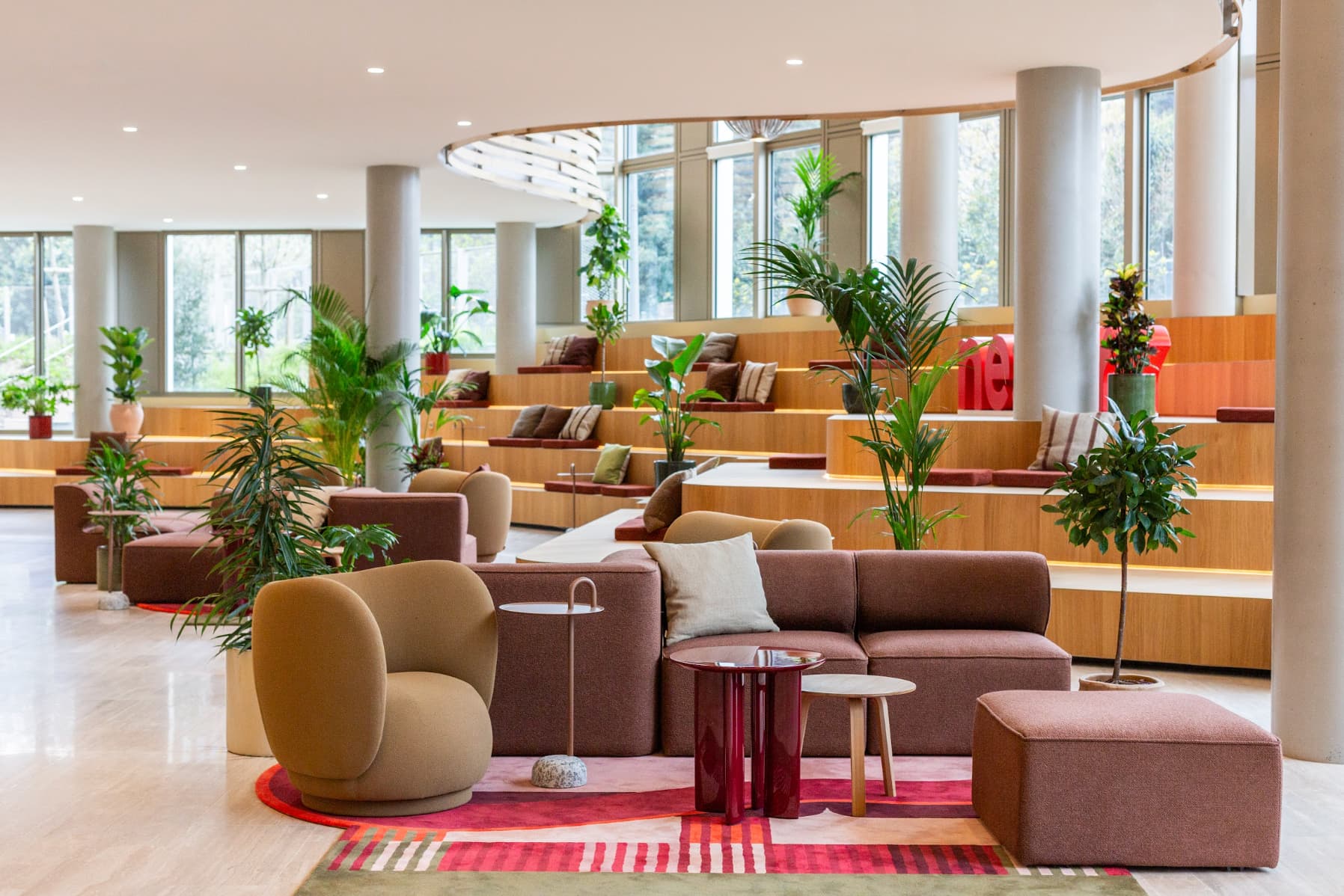
The workspace is the stage for it. An office designed for flow, informal encounters and cross-functional work mechanically produces more connections than a static open plan where everyone stays in their own lane. The idea is not to impose being on-site; it is to make the office a place people choose because it offers something home cannot: connection.
The Cigna data on loneliness at work confirms it: 74% of employees who are not isolated say they are ready to invest more in their company, compared with 63% of those who are isolated. Eleven points of difference that come down, among other things, to the quality of the working environment day to day.
This is one of the convictions that guides the design of Morning spaces: bringing different teams and cultures under one roof, creating the conditions for unlikely encounters, and making the office a lever for connection rather than a mere place of production.
To dig deeper, our article on “project-based working” sets out how this way of working builds connection and strengthens trust between colleagues.

4/ Building more collective moments
To be truly effective, moments of sharing must be designed as bridges between colleagues who do not interact in their day-to-day work.
The United Heroes / OpinionWay 2026 barometer identifies two effective levers:
- The first: head office / field pairings on joint projects. Connecting colleagues from different realities around a shared goal creates a mutual understanding that neither a festive event nor an internal newsletter can produce.
- The second lever: cross-functional onboarding journeys. Making sure new joiners understand from the outset how the whole organisation works, not just their team or department, lays the foundations for a company-wide sense of belonging before the silos even form.
5/ Measure in order to steer
What is not measured cannot be improved. And on the subject of the collective, organisations still lack precise indicators.
Three metrics deserve to be tracked regularly.
First, the belonging score, to be tracked separately for the team and for the company — a single overall average would mask two very different realities, and it is precisely that gap that is revealing.
Next, the sense of fairness by population: head office vs field, generations, roles; to pinpoint the fractures and track how they evolve from one year to the next.
Finally, the perceived effectiveness of collective moments, beyond mere attendance rates: do these moments genuinely create connection, or are they experienced as just one more obligation?
Measuring without acting creates more distrust than not measuring at all. These indicators only have value if they reach the executive committee, on the same footing as the economic indicators, and if they lead to concrete decisions.
Our team is available to assist you.

Download our new study
Nouveaux bureaux : ce qu'attendent les salariés
.png)

.jpg)