

.avif)
You are surely familiar with this situation: yet another meeting that could have been an email. It is a widely shared feeling since, according to a Slack study of more than 10,000 workers, more than two hours a day spent in meetings marks the tipping point at which productivity begins to fall significantly. More telling still, more than a quarter of employees (27%) feel they spend too much time in meetings, a figure that climbs to 55% among senior executives.
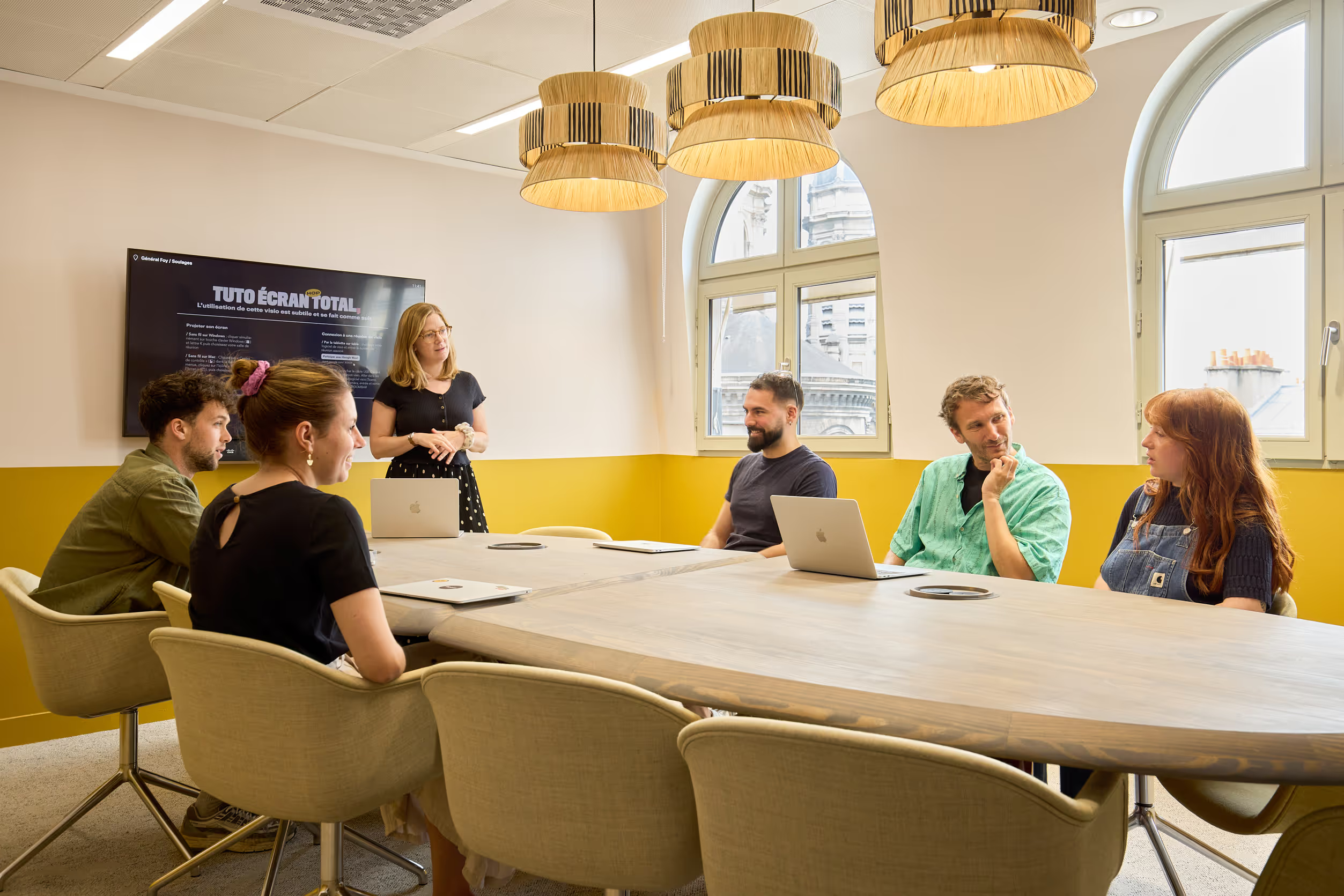
From preparation to facilitation, by way of choosing the format and assessing the results, let's discover together how to turn your meetings into genuinely productive moments. There is no miracle recipe, but there are practical solutions tested in the field.
1. What is at stake in an effective meeting
Boosting your productivity
The Slack study reveals a clear-cut finding: beyond two hours of meetings a day, the majority of employees feel overwhelmed. This overload has a direct impact on their ability to concentrate - people who spend too much time in meetings are twice as likely to run short of time for their core work. A vicious circle then sets in: the more time you spend in meetings, the less productive you are, which creates the need for more meetings.
(Find hundreds of fully equipped meeting rooms in our Morning spaces)
Saving time and money
The financial impact of ineffective meetings is considerable. According to figures from the Observatoire de l'Infobésité et de la Collaboration Numérique (OICN), published by Mailoop in 2025, French executives spent 36 hours and 20 minutes a week in meetings in 2025. For managers, the average is 22 hours and 17 minutes a week, and for other employees it is 10 hours and 12 minutes. According to cross-referenced studies by IFOP and Wisembly, a French worker spends an average of 27 days a year in meetings. These figures can be found in the article published by BLOG RH: Réunionite aiguë : le fléau silencieux qui dévore la productivité de vos équipes
Beyond the direct financial cost to companies, these unproductive meetings generate growing frustration among employees, affecting their engagement and motivation, because they are prevented from working on substantive matters.

2. Preparing your meeting well
Defining the objectives of the meeting
The SMART method provides an excellent framework for structuring your meeting objectives. A Specific objective allows you to define clearly the expected result.
It must be Measurable so you can assess whether it has been achieved, Achievable to maintain motivation, Realistic in light of the resources available, and Time-bound to create a sense of positive urgency.
Assigning roles proves just as crucial. The organiser sets the framework and ensures the objectives are met. The timekeeper keeps an eye on the timing, while the scribe captures the key points. Finally, the facilitator energises the discussion and keeps all the participants engaged.
This preparation also includes choosing the meeting room: capacity, available equipment, location... all criteria that will directly influence how effective your discussions are.
Choosing the right format to get together
The choice of format depends on several interdependent factors.
The nature of the subject, whether strategic, routine or creative, directly influences the type of meeting to favour. The profile and location of the participants, as well as the budget and logistical constraints, also steer this crucial choice.
☞ The in-person format fosters richer communication, both verbal and non-verbal. It strengthens team cohesion and proves particularly well suited to sensitive or complex subjects. A well-equipped meeting room maximises these advantages.
☞ The remote format, for its part, offers great flexibility and makes organisation easier, but calls for shorter sessions to hold people's attention.
☞ The hybrid format combines the advantages of both approaches. It allows for better inclusion of teams and adapts to individual constraints. However, it requires particularly careful facilitation and a meeting room fitted with high-performing hybrid equipment to guarantee a fair experience for participants present in the room and those joining remotely.
Creating a clear, precise agenda
An effective agenda is built around 15 to 20-minute segments, helping to keep participants' attention. It always sets aside time for questions and strategic breaks for meetings running longer than an hour. Circulating the preparatory documents beforehand allows everyone to arrive prepared and to make the most of the discussion time.
The agenda must also allow for the logistical aspects: booking the meeting room, checking the equipment, and arranging the space to suit the needs of the session.
3. Involving the participants
Managing personalities
The art of running a meeting lies in the ability to manage different personalities. The talkers need a kind but firm framework. The shy need to be drawn out with care so they will share their valuable points of view. Those who push back can become real assets when their objections are turned into opportunities for improvement. As for the active contributors, valuing their input encourages a positive dynamic. It falls to the facilitator to juggle all these personalities and draw out the best in each of them.
The classic techniques for engaging people
PowerPoint, or other available formats, remain valuable allies for your presentations, provided you follow a few simple rules. The watchword is “keep it light”.
Aim for ten slides maximum for a twenty-minute presentation. Focus on a single strong idea per slide. And to hold your audience's attention, favour visuals: they should take up 70% of your slides, against 30% for text.
To make your discussions more lively during meetings, you need to give a simple framework for speaking up. Allow each speaker two to three minutes. And make sure the participants listen to one another, without interrupting. At the end of each contribution, you can take a moment to summarise the important points and so make sure everyone has understood the idea being put forward.
The equipment in your meeting room - a good-quality screen, a high-performing audio system, reliable connectivity - largely determines the success of these presentations.
4. TOP 5 original techniques for engaging participants
In the digital age, plenty of tools bring a breath of fresh air to our meetings. Platforms such as Klaxoon, Miro or MURAL offer collaborative whiteboards that allow all participants to take part at the same time. These digital tools, coupled with the facilitation techniques we are about to discover, make it possible to turn your meetings into genuine moments of collective intelligence.
No. 1 Thinking pods
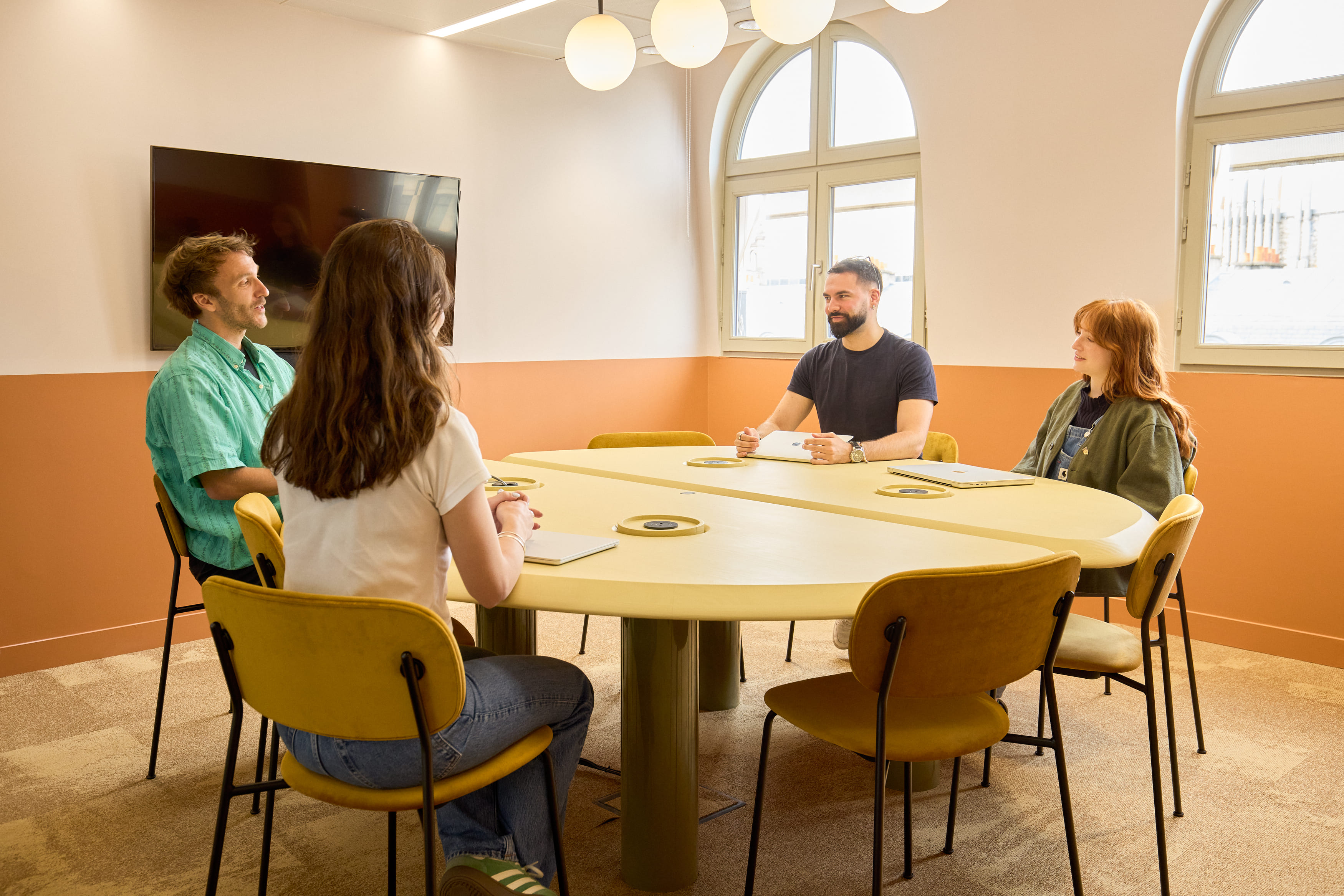
This method involves dividing the participants into small groups of three to four people. Each pod is given a specific mission and a limited time in which to complete it. The advantage? More reserved personalities express themselves more easily in a small group, and the final pooling of ideas allows perspectives to be cross-referenced. For a one-hour meeting, allow 20 minutes of work in pods and 10 minutes to report back to the whole group.
No. 2: The double funnel
This technique structures the creative process into four distinct phases. First, a 20-minute opening phase where all ideas are welcome. Next, 10 minutes of sorting to group similar proposals together. Then comes the moment to choose the most promising ideas together. And finally, the drawing up of a concrete action plan. This method combines creativity and pragmatism perfectly.
No. 3: Oblique strategies cards
Inspired by the work of Brian Eno, this technique uses concept cards drawn at random to stimulate creativity. For example, a card might suggest "What if we did the opposite?" or "What would our competitor do?". These unexpected associations force the group to explore avenues it would not have thought of on its own.
No. 4: Speed Consulting
This technique draws on agile methods: one participant sets out a problem in 3 minutes, then for 7 minutes the others take on the role of consultants to propose concrete solutions. The exercise is repeated with different participants. The advantage? In one hour, you can tackle 5 to 6 different problems with solutions you can act on straight away.
No. 5: Start, Stop, Continue
A simple but formidably effective method: the group identifies what it needs to start doing (Start), what it needs to stop (Stop), and what it needs to keep up (Continue). In 30 minutes, you obtain a concrete action plan shared by everyone. The advantage? This technique makes it possible to tackle sensitive points constructively while acknowledging what is already working well.

5. Assessing the impact of your meeting
Quantitative measures
To measure the success of your meeting easily, base yourself on the figures. First, look at the number of participants present. Then, check whether you kept to the planned duration. Finally, count the number of decisions taken and actions to be carried out. By tracking these points regularly, you will be able to improve your future meetings with ease.
Qualitative measures
Beyond the figures, three key indicators are worth watching: the feedback from participants, the concrete implementation of the decisions taken and the results achieved against the objectives. By analysing these points regularly, you will be able to fine-tune your practices and make your meetings more productive.
***
And there you have it, you are now ready to run your next meeting.
Besides, if you are looking for a venue, you have come to the right place, Morning has some to offer you.
Our team is available to assist you.

Download our new study
Nouveaux bureaux : ce qu'attendent les salariés
.png)

.jpg)