

Last week, a close friend confided that he was pleasantly surprised by how productive he was working remotely. Like a good many people in France, he was trying out the practice for the very first time – forced into it by circumstance.
Listening to him, it dawned on me that I’d got it badly wrong ;) Twice over, in fact… Here I am, having spent years championing new ways of working with my teams, and I’d failed to convince someone close to me that he could work effectively from home. Worse still: I’d failed to explain to him what remote work actually is.
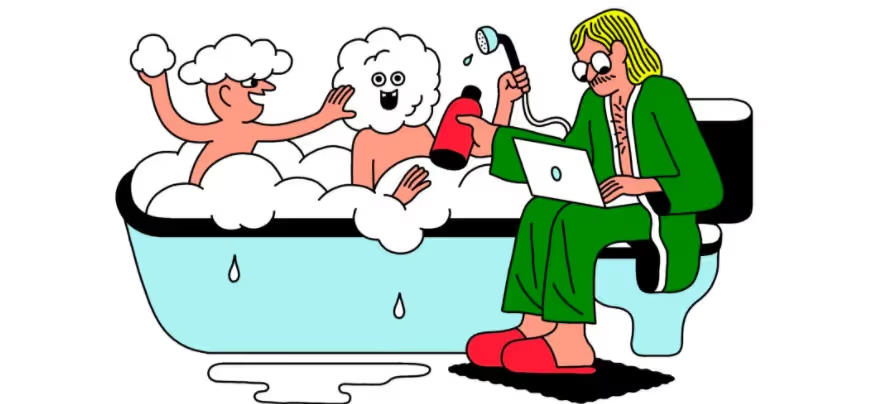
Because no, working from home for two months solid isn’t remote work. That’s lockdown! Granted, realising that you can work from home is already a good start. It’s even a necessary condition for remote work – but not a sufficient one. Not remotely sufficient, in fact, going by some recent figures*: 30% of remote workers see their physical and mental health suffer, and 45% can’t switch off from work. Not great, then.
“Spending two months grafting away in your kitchen runs counter to the very essence of remote work”
In reality, spending two months grafting away in your kitchen runs counter to the very essence of remote work, whose whole point is to shake up the “space-time-work” equation so we can organise ourselves better, live better and work better. By its very nature, remote work involves:
- Several spaces : at home, in your “conventional” office (independent or within a coworking space), in an occasional third place (a café, a coworking day pass), and so on.
- Several rhythms: “on Mondays”, “every other week”, “Wednesday afternoons”, and so on.
Beyond that, everyone is free to organise things their own way.
And that’s where another aspect of remote work slips in: the human one. For me, it’s at team level that the needs of individuals and those of the collective have to be balanced. In the mix: hours of work you can get through on your own versus hours where in-person interaction in a shared workplace is essential. These rather fine adjustments can only be worked out at team level. An employer forcing staff to work remotely x days a month would make no sense – especially when the decision is driven by money matters…
“The office of tomorrow will be less a place of production and more a space for expression”
Today, the influx of millions of new post-Covid remote workers is compelling the state to draw up guides to “best practice” between employer and staff. That’s only right – it’s essential to give all this a legal framework. That said, we need to bear in mind that remote work isn’t settled along the “employer-employee” axis, because there’s no “one-size-fits-all” model. It’s for the team to decide, in light of the projects and each person’s profile.
This new population of remote workers should have some pretty remarkable consequences for the way workspaces are organised. If ever more “individual working hours” are going to take place away from office spaces, then those spaces will have to transform to make room for more creativity, and more collaboration still, to help the business grow. The office of tomorrow will be less a place of production and more a space for expressing company culture and, by extension, a space for social interaction.
In fact, I don’t think I like the word “remote work”. It sounds too much like “working in front of the telly”; it conjures up an image of downtime for the employee and mistrust from the employer. We’re a long way from the notion of trust that should allow both employee and manager to feel liberated and to take on greater responsibility.
Ultimately, remote work is only a stage. Tomorrow, we could all be working remotely all the time! The office, the home and coworking spaces will be places we choose day by day according to our needs and to a balance between professional productivity and personal well-being – two things that are inextricably linked.
There’s no point inventing another word that would fit the reality of “remote work” better, because I think it will soon be put into practice (properly) by the great majority. In two months, we must have gained a good five years in rolling it out… And once everyone has taken it up, we’ll call it by a word that already exists. Work.
Our team is available to assist you.

Download our new study
Nouveaux bureaux : ce qu'attendent les salariés
.png)
.jpg)