

The Morning team has been creating workspaces since 2014. Within our business, furniture has always held a special place. Initially, furniture served a twofold purpose: to meet the needs of the working world and to contribute to the look of our spaces. The challenges of our times have imposed a third purpose on it: to have a minimal environmental impact.
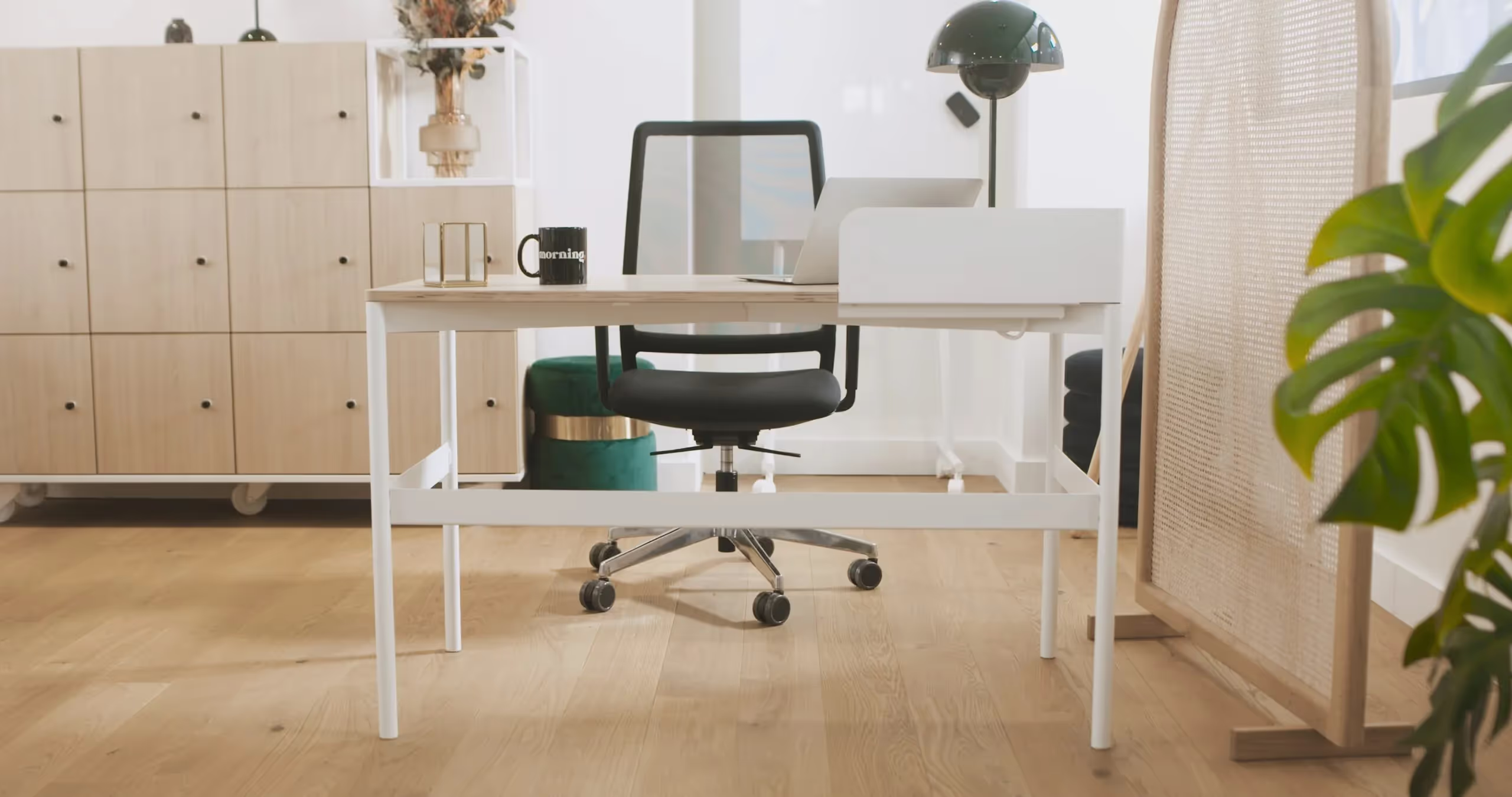
We set about creating our own eco-designed range in 2020. As the flagship of our range, the desk was where we focused our first efforts. Our approach unfolded in two stages. The team first carried out a Life Cycle Assessment (LCA) of the eco-designed desk to take an uncompromising stock of where we stood, thanks to our partners (👋 the EVEA consultancy). We were then able to prioritise and set our actions in motion at every level. Here’s the full story.
STAGE 1: Carrying out the Life Cycle Assessment (LCA) of the eco-designed desk
And grasping the (vast) task ahead.
Morning is among the few players in the furniture sector to have carried out a Life Cycle Assessment (LCA) of its entire range. Yet this step is essential for steering your choices well and measuring your results.
The principle of a product’s LCA is to measure its environmental impact, “from cradle to grave” as the English say. Raw materials, manufacturing, transport, use, end of life… nothing is left out! For each stage, five indicators are measured: greenhouse gas emissions, particulate matter, freshwater eco-toxicity, fossil-fuel consumption and consumption of non-renewable resources.
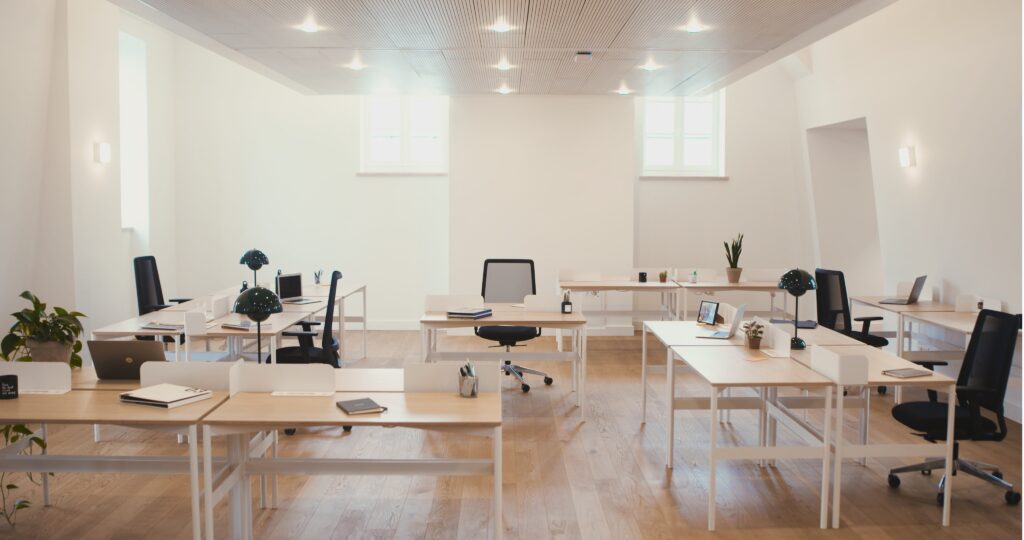
By December 2019, the desk’s LCA was complete. By identifying the most “costly” areas, we were able to prioritise our actions, quantify our objectives and announce our first results this year. And so the 2022 edition of our desk has a carbon footprint 17% lower than its predecessor. It’s also 20% lighter, thanks to a 50% reduction in the amount of steel.
STAGE 2: ECO-DESIGNING, AT EVERY LEVEL
The whole art of rethinking what you do.
80% of a product’s environmental implications are determined during the design phases. That’s where the key questions arise: How do you optimise the amount of material used? What shape should you adopt to minimise offcuts? Which assembly system should you choose to ensure the components can be separated? Each new edition must reduce its impact without diminishing its qualities in use – quite the opposite. Here we share a few points that have allowed us to reduce our impact significantly.
☞ Parts that can be (dis)assembled endlessly
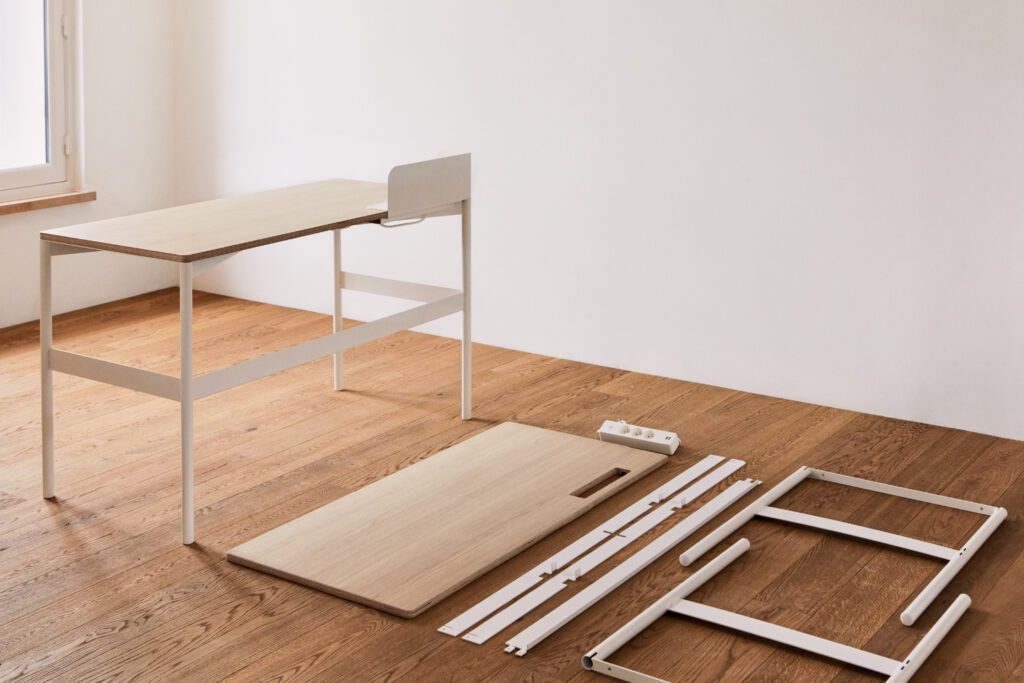
The assembly systems are a key point. They ensure the components can be separated and therefore make them easier to repair and reuse. That’s why the top – in birch plywood and oak laminate – has a screwless assembly system that allows it to be taken apart smoothly, without a hitch or any damage.
Choosing a 100% steel structure serves the same end, since this material is easily detachable and endlessly recyclable. Another advantage worth flagging: because the components can be separated, the carbon impact of transporting them is reduced.
☞ Material consumption (better) kept in check
To reduce the amount of material used, several levers are pulled: the quantity of materials, of course, but also the cutting shapes, which have to be simplified to minimise waste. The number of materials also has to be reduced to make the product easier to recycle. It’s worth pointing out that these choices in no way undermine the strength and core qualities of the desk.
Plenty of other material-related choices help reduce the desk’s impact. The steel of the legs and the rack is shaped into flat-stackable cross-members (rather than tubes) to avoid any waste. What’s more, the parts are triangulated for an assembly that’s ever more sparing in raw materials. This system is “screwless” and… flawless!
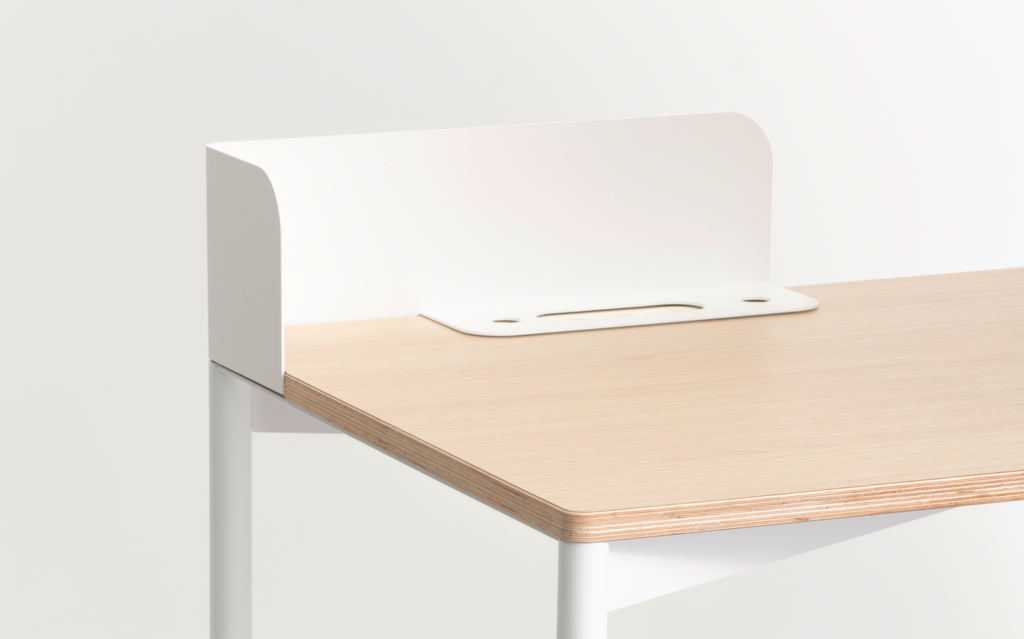
We also ban all harmful glues and paints of every kind. Being in birch plywood, the top also needs less glue to be fixed to the legs. And to keep improving our environmental record, our manufacturers protect the steel with epoxy, a protective paint that’s non-toxic to the environment.
☞ Made in France manufacturing and European sourcing.
The Morning team is committed to sourcing from French manufacturers. The impact of a local network is twofold: transport times are optimised and local employment is supported. This closeness also fosters dialogue with our manufacturers and greater control over what we make.
Our eco-designed desk is made and assembled in France, by various operators in Ille-et-Vilaine, Calvados and Deux-Sèvres. As for our materials, they are all of European origin. First from Ille-et-Vilaine for the steel, from Poland for the birch plywood and from Germany for the oak laminate of the top.

The eco-designed work desk now holds no more secrets for you. For the more curious among you, note that we also design and make our own tables (one-off model) for the meeting rooms of the Concorde space. And if you’d also like to discover our waste-reduction initiatives, head here.
☞ If you’d like to receive our catalogue of eco-designed furniture, drop us a line at: mobilier@morning.fr
☞ Morning joins B Corp, the community of purpose-driven businesses
☞ Morning launches an Accelerator for responsible fit-out solutions
☞ 5 tips for obtaining B Corp certification
Our team is available to assist you.

Download our new study
Nouveaux bureaux : ce qu'attendent les salariés
.png)
.jpg)