


.avif)
63% of French people who have been through a situation of vulnerability that affected their working life feel that the support provided by their employer was not sufficient. This figure reveals a deep gap between organisations’ stated intentions and the real experience of their employees.
Bereavement, illness, burnout, separation, being a carer, assisted-reproduction journeys, hardship, addictions… These situations are neither marginal nor exceptional. They touch everyone — employees in every company, at every level of the hierarchy, in every profession. And yet they often remain invisible, seldom voiced and insufficiently supported.
Here we share a few tips for doing better. This content comes straight from the exchanges between Pascaline de Broissia (L’Équipage) and Éric Coisne (RAISE), guests of Morning’s Bureau des Talents, hosted by Mélanie Nabucet (HR at Morning) on 15 January 2026. This round table devoted to vulnerability set out to shift perspective and offer practical levers for weaving vulnerability into your organisation’s practices. Audio recordings of our two speakers round off the written summary of their remarks.
Shifting perspective
84% of French people still associate vulnerability with a negative connotation. This perception is no accident. It is the product of a professional culture — and indeed a wider one — that prizes mastery, certainty, sustained performance and self-control.
From the moment we enter the world of work, an implicit message is often passed on: emotions, fragilities and personal difficulties should be left at the office door. As if we could compartmentalise our lives, leave our “personal baggage” at the bottom of the lift and then function as neutral, rational individuals.
Yet this view is at odds with human reality. We are not two separate people at the office and at home. Life’s ordeals inevitably reach the professional sphere: they affect attention, energy and motivation, as well as our relationships with others.
Shifting our perspective on vulnerability means recognising that fragility is part of the human experience, and that it can become a collective resource when it is welcomed within a safe framework.
Pascaline de Broissia, on the lack of awareness around vulnerability.
Vulnerability as a binding force within the company
When it is acknowledged and supported, vulnerability becomes a genuine strength for the company’s cohesion and momentum.
First, it strengthens trust and bonds. Daring to say that you are going through a difficult time opens up a more authentic relationship. It creates closeness, reduces unspoken tensions and encourages mutual support.
It also improves the collective’s adaptability. An organisation able to listen to weak signals, adjust its ways of working and take individual realities into account is more resilient in the face of crises and change.
It also contributes to psychological safety, a recognised foundation of lasting performance. Being able to say "I don’t know", "I didn’t understand", "I need help" without fear of being penalised. This is the bedrock of all cooperation, the ideal ground for every future initiative.
Finally, vulnerability unlocks creative potential. By allowing for uncertainty, doubt and experimentation, it opens the way to new ideas and co-created solutions. This reality had already been brought to light by Project Aristotle, run by Google in 2012: the common denominator among the highest-performing teams is psychological safety.
Within these teams, everyone has the right to make mistakes. In other words, no one is expected to strike a pose of invulnerability or omnipotence. Employees can put forward an idea, formulate a hypothesis or ask a question without fearing judgement, failure or having their legitimacy called into question.
This climate of trust is a prerequisite for innovation. A company that innovates is, by definition, a company in which many projects come to nothing.
Failure is an integral part of the process. Conversely, where there is no right to make mistakes, teams censor themselves. They favour tried-and-tested, reassuring solutions at the expense of the risk-taking that is nonetheless necessary. And without uncertainty, innovation is impossible.
5 tips for weaving vulnerability into your company
1. Embody vulnerability (for leaders)
This is the essential starting point: if leaders and members of the executive committee never show their doubts or their limits, it is unrealistic to expect employees to do so.
Embodying vulnerability does not mean offloading emotionally onto your teams, but accepting that you do not know everything — and saying so.
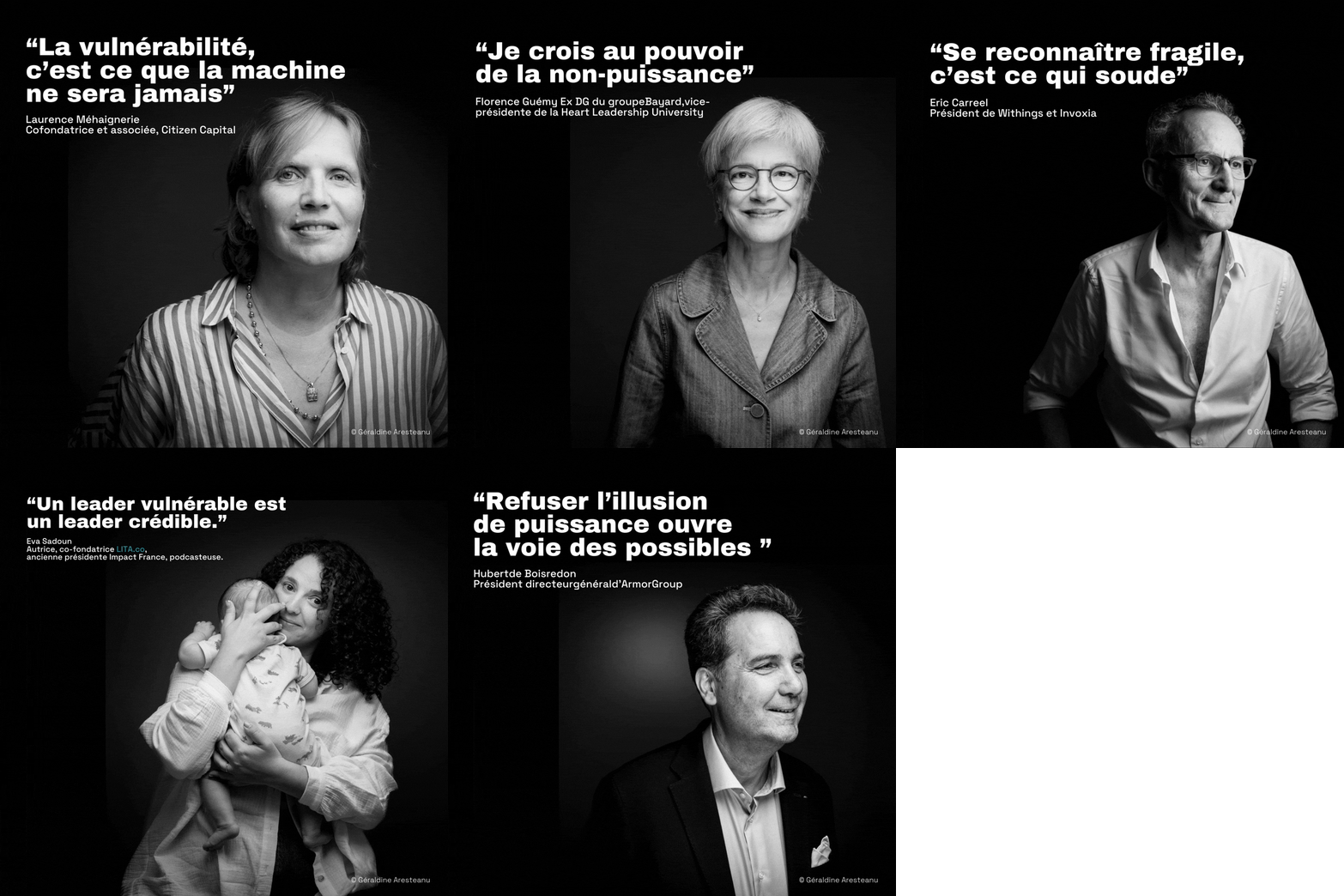
Hubert de Boisredon, head of the Armor group, explains in his book Le Courage des Chefs how a seemingly simple question — “How would you do it?” — profoundly transformed his relationship with his teams and the quality of internal dialogue.
Eric Coisne, on how leaders position themselves in the face of vulnerability.
Beyond leaders, everyone can embody / acknowledge their vulnerability at their own level. In concrete terms, this can involve simple gestures:
- Saying “I don’t know” in a meeting
- Sharing strategic questions and seeking the teams’ views
- Acknowledging uncertainty rather than feigning total mastery
2. Create spaces of psychological safety
Vulnerability can only be expressed within a safe framework. Without this safety, it is harder — not to say impossible — to open up without fearing judgement, penalty or exclusion.
Creating this safety does not necessarily require heavy-handed schemes, but rather regular, sincere practices.
Several simple levers help open up this space:
- Regular one-to-ones, with an empathetic question:
“How are you feeling at the moment? Is there anything I should know?”
Asked consistently, this question becomes a signal that it is safe to speak. - Dedicated collective moments for sharing, such as workshops, talking circles or more informal formats. They help normalise the expression of fragilities and break isolation.
However, creating a space of safety is not enough if you cannot detect the weak signals. You can only support what you see — and a large part of vulnerability remains silent.
This is where certain tools support managerial attention:
- Regular internal barometers. Their strength lies in their simplicity and their repetition. What matters is not the raw score, but how it changes over time. A gradual, repeated decline can reveal distress before it is explicitly voiced.
- Analysis of verbatim comments. Certain phrases are valuable indicators:
“My work feels less meaningful”, “I’m sleeping badly”, “I feel less like coming to work”. - Appointing a clearly identified point of contact, along the lines of what exists for harassment or internal violence. A trained, neutral person whom employees can turn to without going through their direct line manager.
These tools do not create psychological safety on their own. They do, however, make it possible to pick up weak signals before they turn into critical situations.
3. Train managers in a listening posture
Managers are on the front line when it comes to vulnerability, yet they are rarely trained to support it. Most management training still overlooks this human dimension.
Training managers means giving them reference points, tools and, above all, a posture.
Short training sessions can be put in place, notably around Nonviolent Communication (NVC). This approach makes it possible to identify one’s own emotions and needs, to listen without interpreting or judging, and to set a clear framework without violence. It invites you to slow down and ask the right questions before acting.
A key point is to work on the manager’s “right place”: neither positioning yourself as a rescuer, nor slipping into avoidance, but supporting through co-creation.
Faced with a situation of vulnerability, one of the most common reflexes is to want to “do the right thing” quickly. Reorganising the team, cutting off communication, deciding on a protective way of working.
The road to hell is paved with good intentions. A frequent mistake is to try to protect someone by deciding on their behalf. Some managers will thus gather up all the messages from a team to pass them on to a colleague who is ill, so as to spare them any disturbance. Yet the person in question will on the contrary want news from everyone, and such a move may ultimately be read as abandonment. To illustrate this point, Pascaline De Broissia quoted Nelson Mandela: “Everything that is done for me without me is done against me.”
Mélanie Nabucet, on the link between vulnerability and Nonviolent Communication.
4. Tailor the support
Vulnerability cannot be standardised. Two people facing a similar situation — illness, bereavement, exhaustion — will not necessarily have the same needs, the same pace, or the same expectations of their work and their colleagues.
The first question to ask is not “What can I put in place?” but: “What can I do for you, today?”
This question opens up a space for dialogue in which the employee remains an active participant in their own support. In particular, it helps clarify how they wish to stay connected with the team:
- The preferred channels (email, message, call, WhatsApp)
- How often to be in touch
- The people they wish to stay in contact with
Pascaline de Broissia, on the search for tailored solutions.
It is just as important to accept that these needs evolve. The first days of an ordeal are often marked by a form of shock. Then come other phases: a need for connection, a need for meaning, a wish to gradually take one’s place again within the collective.
Pascaline de Broissia, on the importance of listening to people’s needs.
5. Encourage solidarity between peers
Support from colleagues is often felt to be more helpful than support from management or HR. The absence of any hierarchical stake makes it easier to speak up and to help one another.
This starts with simple, informal rituals:
- Team lunches
- Coffees with no agenda
- Group walks
These informal spaces are often where words flow most freely, where a colleague can say “I’m not doing great at the moment” without it immediately taking on an institutional dimension.
It is also about valuing mutual support as a skill in its own right. Caring for others, knowing how to listen, spotting a colleague in difficulty — this is an essential contribution to how well the collective works.
The metaphor of the piece of paper on the floor says it well: in a small organisation, everyone picks it up. In a large one, everyone assumes that “someone else will deal with it”. With vulnerability, the risk is the same. It must not become the business of HR alone.
Eric Coisne, on the importance of individual responsibility within large companies.
Towards a new model of the company
In Japan, the art of kintsugi consists in repairing broken objects with gold powder. The cracks are not hidden: they become visible and precious.
A company that integrates vulnerability works in the same way. It does not seek to mask fragilities, but to support them so as to turn them into points of support.
Integrating vulnerability does not mean giving up on performance. It means choosing a performance grounded in trust, cooperation, psychological safety and creativity.
It also means recognising that we are not machines, but human beings shaped by our ordeals — and that these ordeals, when supported with care, can strengthen the whole collective.
Eric Coisne, on vulnerability and the Japanese technique of kintsugi.
Our team is available to assist you.

Download our new study
Nouveaux bureaux : ce qu'attendent les salariés
.png)

.jpg)